
The QPath Blog
A guide to getting to know QuantumPath

The platform

QuantumPath® can be accessed from https://core.quantumpath.app/ and once there you will need to click on the login button and complete the platform access details.
Once logged in, the Dashboard will appear by default, where the most relevant information recorded in it will be presented. In addition, depending on the profile with which the user has accessed the platform, the user will have access to the corresponding QPath® menu, which consists of the following options:
- Home
- Assets
- System
- Tutorials
- QAPPs
- qSOA®

From the Assets menu, you can access:
- Dashboard
- Statistics Dashboard
- Engineer Dashboard
- Quantum Solution Catalog
- Quantum Circuit Catalog
- Resources Catalog
- Quantum DirectCode Catalog
- Quantum Circuits Flow Catalog
The Engineer Board is an option that makes it easy to work with system assets.

Among the options designed to provide support and assistance to users, we highlight the following:
- Menu option to access tutorials, which contain a wide variety of use cases relevant to quantum computing whose algorithms have been implemented in QuantumPath®, thus serving as a guide for those who wish to use this type of support during their first steps on the platform.
- Request Help and Feedback button.
- Tips and Announcements button.
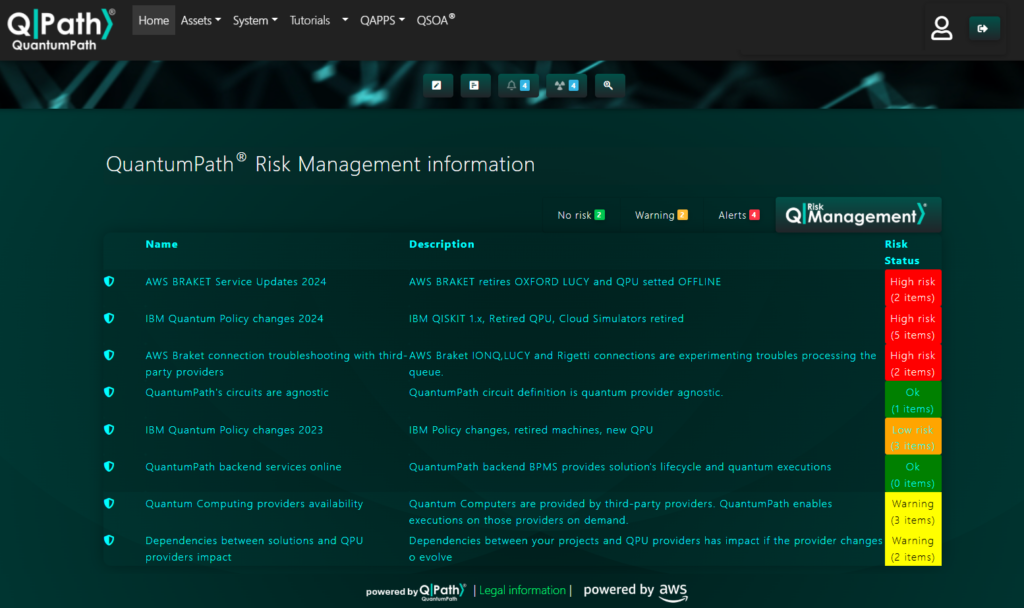
- Button to access QuantumPath® risk management information.
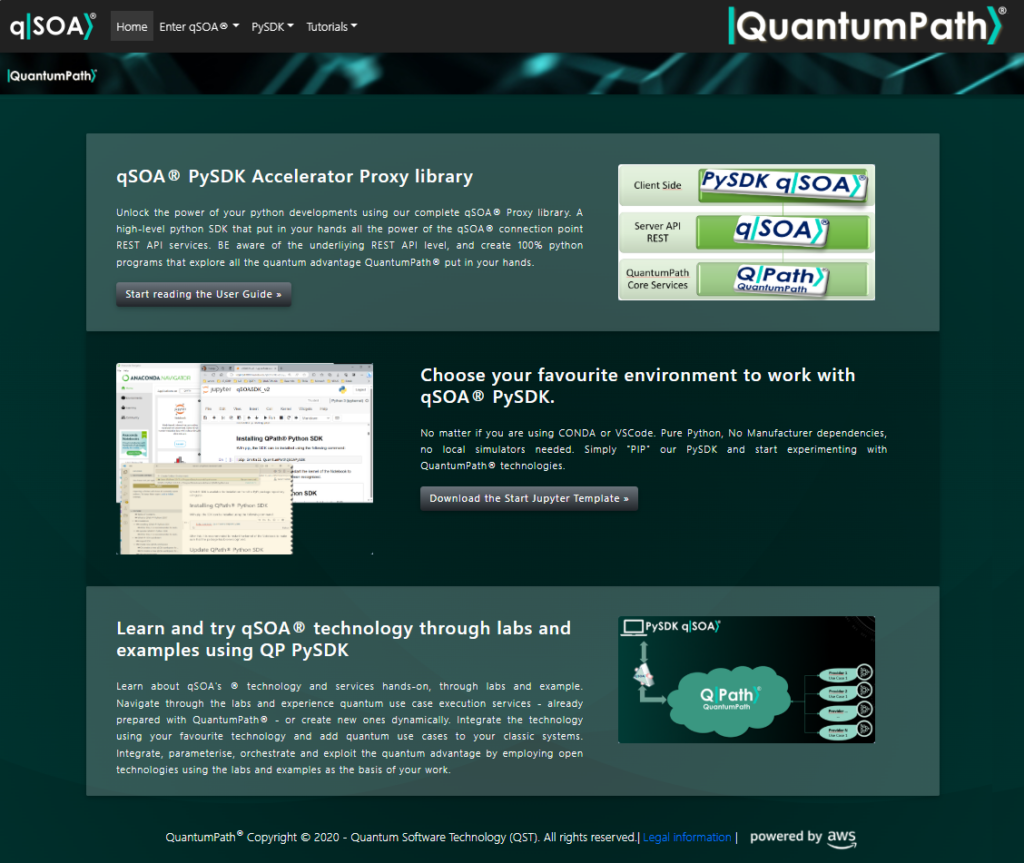
For the development of hybrid software systems, QuantumPath® provides the qSOA® architecture, a mechanism for the dynamic integration of quantum/classical software systems, which can be accessed on the platform via the qSOA® menu option.

The qSOA® environment also provides access to the qSOA® Proxy Library qSOA® PySDK Accelerator, a high-level Python SDK that gives QPath users the full power of the qSOA® Connection Point REST API services.
Other resources to learn about QuantumPath®
As part of the ongoing process of designing, developing, and promoting QuantumPath® over the past few years, we have published a number of resources (videos, articles, webinars, etc.) that address specific communication needs. Most of these resources are published on The QuantumPath Blog and the aQuantum Channel on YouTube.
Most of these resources are complementary to each other and can therefore be presented in a way that they follow a logical sequence to facilitate the knowledge of QPath®, so I will show below a guide, a route, with an ordered sequence of the existing public resources that allow to know the most relevant elements of the architecture and functionalities of QPath®. This guide is therefore intended as an aid for those who wish to easily access the information published on the Internet about QPath® features.
Bearing in mind all the above, to those who are thinking of starting in the development of quantum APPs with QuantumPath®, but who don’t have previous experience in the development of quantum software, I suggest that they watch the videos published on the aQuantum Channel, starting with these introductory videos to quantum development [1], designed to contribute to literacy for quantum software development, in the order suggested by Figure 1:
· Quantum concepts [2]
· The physical and mathematical machinery required for quantum programming [3]
· Introduction to quantum programming [6] [7]
These videos were made within the framework of the QANSWER 2020 Webinars, so some of them also correspond to published articles that we consider useful to include in these references.

Figure 1: Introductory videos to quantum programming
If after viewing the videos, you want to know more about quantum development with QPath®, then I recommend reading the articles published in The QPath Blog [8], although for beginners I suggest starting the reading in the order suggested in Figure 2:
· QPath® features [9]
· Introduction to quantum software development with QPath®[10]
· The QPath® approach to quantum annealing [11]
· QPath® solves most of the quality problems of quantum computing platforms [12]

Figure 2: Articles about QPath functionalities
The QPath Blog is a site created to publish technical and opinion articles on QPath®, its architecture, functionalities, as well as the advantages and benefits it brings to its users. It is a living repository, in which we regularly publish specific information about QPath®, so we suggest visiting them regularly to keep up to date on this platform.
And finally, about the actions to learn more about the programming of APPs with QPath®: if after all the previous process you want to see how this platform works in practice, I suggest you attend the aQuantum Webinars [13] in Figure 3:

Figure 3: Cycle of practical webinars on QPath.
In this cycle of webinars, you will be able to know, through practical demonstrations carried out by the authors of QPath®, how to:
· QPath® works
· Develop quantum APPs with a very feasible and pragmatic approach.
· Integrate classical and quantum software with QPath®.
Don’t worry if you can’t attend these webinars because they will be recorded [14]. If you cannot attend them live, you will later be able to watch the videos that will be published on the aQuantum Channel [15].
The videos of the workshop “Introduction to Amazon Braket and QuantumPath: Creating Quantum Solutions” [16] are also very illustratove in this regard.
The aQuantum Channel is a living repository of our activity in the quantum field, our contribution to quantum literacy, so we also suggest visiting it regularly to see our latest publications.
Of course, as you can see on the respective websites there are more published resources than those that I have included in this route, they are all valid to go further in the knowledge about QPath®, but the ones indicated here give rise to a good guide to give the first steps in the world of QPath. There will be time to progressively address more advanced topics about QPath®.
Finally, you can access QuantumPath® online and, if you wish, subscribe to the Free Developer version, which is free, to get to know the tool by doing some development experiments with the platform:

[1] aQuantum Channel https://www.youtube.com/channel/UCrhjVcvHCKI79pjZ6R2ybbA
[2] Serrano, Manuel Angel. aQuantum Webinar: Quantum Concepts. aQuantum Channel.
https://www.youtube.com/channel/UCrhjVcvHCKI79pjZ6R2ybbA. 2020
[3] Murina, Ezequiel. aQuantum Webinar: Quantum Programming the Mathematical and Physics Machinery (in Spanish). aQuantum Channel. https://www.youtube.com/channel/UCrhjVcvHCKI79pjZ6R2ybbA. 2020
[4] García Rodríguez de Guzmán, Ignacio. The Talavera Manifesto for Quantum Software Engineering and Programming. aQuantum Channel. https://www.youtube.com/watch?v=-jUd0hXffu0. 2020.
[5] The Talavera Manifesto for Quantum Software Engineering and Programming. CEUR Workshop Proceedings. http://ceur-ws.org/Vol-2561/paper0.pdf. 2020
[6] Hevia, José Luis. aQuantum Webinar: Introduction to Quantum Development (in Spanish). aQuantum Channel. https://www.youtube.com/watch?v=V44qdI4rl3c&t=173s. 2020.
[7] Hevia, José Luis. Introduction to Quantum Development. CEUR Workshop Proceedings. http://ceur-ws.org/Vol-2561/paper3.pdf. 2020.
[8] The QPath Blog. https://www.quantumpath.es/index.php/articles/
[9] Hevia, José Luis. QPath Features. The QPath Blog. https://www.quantumpath.es/index.php/2020/12/10/qpath_features/. 2021.
[10] Peterssen, G., Hevia, José Luis. Introduction to quantum software development with QPath. The QPath Blog. https://www.quantumpath.es/index.php/2021/01/13/introduction-to-quantum-software-development-with-qpath/. 2021
[11] Murina, E. The QPath approach for Quantum Annealing. The QPath Blog.https://www.quantumpath.es/index.php/2021/02/01/the-world-of-quantum-annealing-according-to-qpath/.2021
[12] Piattini, QPath solves most of the quality problems of quantum computing platforms. The QPath Blog. https://www.quantumpath.es/index.php/2021/02/11/qpath-solves-most-of-the-quality-problems-of-quantum-computing-platforms/ 2021.
[13] aQuamtum Webinars. https://www.aquantum.es/resources/webinars/
[14] aQuantum Videos. https://www.aquantum.es/resources/videos/
[15] aQuamtum Channel. https://www.youtube.com/channel/UCrhjVcvHCKI79pjZ6R2ybbA
[16] aQuamtum Channel.https://youtu.be/Ut3bqjjQyyQ and https://youtu.be/iqSwzShyXrE
