
The QPath Blog

Democracy & Quantum Technologies (III)


As discussed in the previous article [1], he Digital Public Infrastructure (DPI) based on classical computing has made significant progress and will continue to provide important services to citizens in the coming years. However, as we have also seen, its technological nature poses serious challenges in terms of ensuring growth, security, privacy and resilience, which are all essential for the reliable development of a mature digital and democratic society.
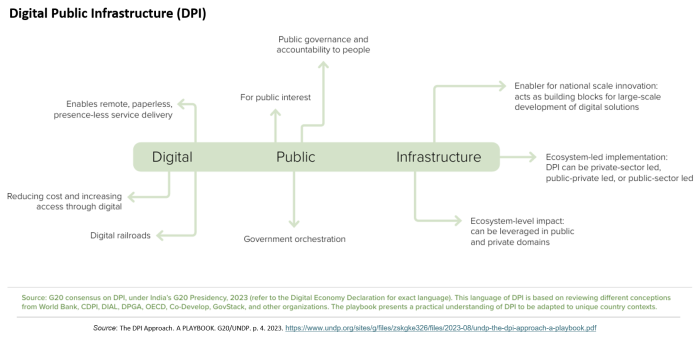
In order to guarantee technological scalability, classical DPI necessitates a cutting-edge technological ‘partner’ to facilitate the attainment of a new level of development: quantum technologies.
Quantum technologies, which are based on quantum mechanical principles and engineering, have significant applications in the following areas:
· Quantum computing
· Quantum communications and cryptography
· Quantum metrology and sensors
· Quantum simulations
All of these will have a significant impact on scientific research and technology, driving major changes in how we apply our accumulated knowledge. Their practical applications will also affect many aspects of our daily lives, including social, economic, institutional, political and democratic relations.
In the case of DPI, quantum computing, communications and cryptography will have the most direct and immediate technological impact.
Hybrid Classical-Quantum DPI for Digital Democracy
As with any disruptive technology that has a profound impact on everything we do, quantum technologies also offer us opportunities in various ways to take the digital public services of DPI and digital democracy to the next level.
In any case, the reality is that quantum technologies are already here; despite their relative youth, their practical applications are gaining ground, and their inclusion in the process of digitizing social activity, to meet needs and overcome weaknesses in the most critical public services, is no longer merely a future possibility but is essential for making these services more efficient and resilient.
The anticipated impact of the convergence of quantum computing, communications, and cybersecurity technologies on the digital transformation of society is also not without enormous challenges and risks for IT systems in general, and for the DPI in particular. The challenge is enormous, given that these are 100% disruptive technologies, something entirely unprecedented, for which there is virtually no accumulated prior experience, either regarding their use or their defense. The computing power they will provide is such that, once fully mature, quantum technologies will offer humanity, for the first time, the ability to understand practically everything around us [2], and to simulate the world we know in real time. And this includes the complexity of being able to account for the enormous number of different probabilities inherent in each process, surpassing in every way the sequential and deterministic nature of classical simulations.
This power gives rise to the paradox of quantum computer security: they dramatically improve information-processing capabilities, but, for that very reason, they also pose a real and imminent risk to computer security. Quantum technologies, like other technologies, are neutral in and of themselves; they are neither good nor bad. But the consequences of their use for humanity will depend on how humans decide to use them, on whether or not those uses are regulated, which may or may not generate a wide variety of risks,and, of course, on how they are protected.
· Among the most obvious immediate risks posed by quantum technologies to the security of the development and evolution of digital systems and platforms,including those related to IPR, the following stand out:Failing to realize that this risk is very real, that we are currently experiencing the beginning of what is known as a retroactive security vulnerability.
· Hackers (operating under all sorts of guises) are employing a strategy known as “harvest now, decrypt later,” and are currently stealing and storing critical information to decrypt it once quantum technologies are ready to do so. If, when that time comes, the confidentiality of the stolen information remains intact, the problem that arises then will have been made possible by what has not been effectively protected today.
· Failing to act now in response to the evidence that quantum technologies are already a reality, and failing to begin taking the necessary measures to mitigate their current and future risks by:
o auditing and analyzing the current state of security and defining a strategy to begin implementing post-quantum security [3], at a minimum, for critical information
o defining the priority order of digital public services that will need to be protected against the security threat posed by quantum computing
o initiating quantum literacy efforts and raising awareness of the benefits and risks of quantum technologies for society
· Failing to act now, with clearly defined action plans, to prevent a situation where, once quantum computers reach the capacity required to break classical cryptography, including that of today’s most powerful encryption systems, they compromise classical computer systems in the following areas:
o Public administration
o Critical infrastructure
o Water and food
o Power plants and energy grids, and nuclear power plants
o Healthcare
o Financial system
o Telecommunications
o Etc.
o Chemical industry
o Research
o ICT
o Transportation
o The Internet
o National security
o Etc.
· Failing to take the necessary measures to ensure that, from the outset (unlike what is happening with AI), the development and use of quantum technologies comply with democratic principles and clearly defined ethical and legal standards [4]
· The formation of political/technological monopolies that become lobbying groups promoting their own interests, outside of a democratically defined general framework for action
· Failing to proactively address the quantum talent gap to create the skilled workforce needed by the quantum industry and for the development and maintenance of hybrid systems [5]
· Failing to continuously and consistently assess and mitigate the evolving technological risks in the development of quantum software and hybrid systems designed to provide digital public services to citizens [6]
· Failing to recognize the global quantum technology gap, in which a small group of countries concentrates global quantum power, a situation that will severely affect:
o countries with fewer resources, increasing global inequality
o geopolitics, even more so than is currently the case [7]
· Failing to thoroughly prepare to identify, manage, and mitigate sophisticated hostile foreign attacks that will target the country’s democratic normalcy using quantum technologies
The DPI’s digital systems and platforms are prime targets for hackers. Therefore, the UNDP and all relevant institutions and organizations worldwide that promote DPI and develop its digital systems and platforms must not waste time; they must actively work to implement, at a minimum, the following recommended steps to transition to post-quantum cryptography:
· Raise awareness about the quantum threat and educate users on its risks and ways to mitigate them
· Develop a risk management plan and prepare for the quantum threat
· Understand the data’s lifecycle, identifying its relevance and security status
· Identify where vulnerable algorithms and systems are used to plan for their urgent replacement and/or update
· Determine the criticality level of deployed systems and data to establish, on that basis, the order of priorities for the transition
· Begin migrating their systems to quantum-resistant cryptography
· Use hybrid security solutions during the transition
· Work with the concept of layered security, paying special attention, in the initial stages, to the security of communications, the network, applications, and critical data
Those who have not yet begun their practical journey toward quantum-resistant security are already dangerously behind; this is the only way to mitigate the quantum threat to the cybersecurity of their systems and digital platforms.
In terms of security, DPI could “simplify” the work involved, reduce costs, time, and risks by utilizing the tools, specialized services, and publicly available expertise to mitigate the quantum threat:
· Post-quantum cryptography (PQC)
· Quantum key distribution (QKD)
· Quantum Random Number Generation (QRNG)
· Quantum/classical software secure by design
· Working with reliable security information, tools, and standards, real-world use cases, etc., which are regularly released and updated, such as:
o NIST’s Post-Quantum Cryptography (PQC) Project, which publishes algorithms and standards designed to withstand future quantum attacks and incorporates them into the Federal Information Processing Standard (FIPS):
§ The FIPS 203 (Federal Information Processing Standard) was conceived as the primary standard for general-purpose encryption. The standard is based on the CRYSTALS-Kyber algorithm, which has been renamed ML-KEM, an acronym for Module-Lattice-Based Key-Encapsulation Mechanism.
§ FIPS 204, designed as the primary standard for digital signature protection. The standard uses the CRYSTALS-Dilithium algorithm, which has been renamed ML-DSA, an acronym for Module-Lattice-Based Digital Signature Algorithm.
§ FIPS 205, also designed for digital signatures, uses the Sphincs+ algorithm, now called SLH-DSA (stateless hash-based digital signature algorithm).
o The European Commission’s roadmap for the coordinated implementation of the transition to post-quantum cryptography (PQC), with the goal of deploying PQC technologies in existing public administration systems and critical infrastructure across the European Union and its member states. This roadmap envisages the use of hybrid schemes that can combine PQC with existing cryptographic approaches or with quantum key distribution
§ Roadmap for the transition to PQC
§ PQC Roadmap: Frequently Asked Questions
o Follow the publications of the European Union Agency for Cybersecurity (ENISA), the EU body dedicated to improving the reliability of ICT products, services, and processes through cybersecurity certification systems. Among others, the following resources are noteworthy:
§ NIS2 Technical Implementation Guide
§ Cybersecurity in Critical Sectors
o Learn about this excellent real-world example of how to take responsibility (in this case, at the national level, in one of the world’s leading countries in quantum technologies, the Netherlands) when the importance of the quantum threat, which could break the cryptography of current encryption systems in the near future, is recognized [8]:
In February 2026, a report by the Netherlands Court of Audit found and made public that 71% of the central government organizations surveyed had not begun preparing for the threat that quantum computers pose to their encryption systems.
Eight months later, the Jetten Cabinet (the Dutch government) submitted the government-wide quantum strategy (currently available only in Dutch) to Parliament, in which it defines the QPC migration goals for central government organizations. The goal is to complete the migration of high-risk use cases by the end of 2030 and of medium-risk use cases by the end of 2035. The decision is based on the forecast that between 2029 and 2035, a quantum computer capable of breaking current public-key cryptography will already be available, and it cites advice received from the General Intelligence and Security Service (AIVD) to prepare for its availability starting in 2030. They define this as an important step toward the Netherlands’ quantum future.
In the section on Central Government Preparedness for the Quantum Threat in Chapter 4, Security, the following PQC Migration Timeline [9] is presented for the Dutch Central Government, which, according to the Cabinet, aligns with the European Union’s Coordinated Implementation Roadmap for the transition to PQC:
No later than the end of 2026:
§ Central government organizations have incorporated the risk posed by quantum computing technology into their risk management process.
§ Central government organizations have their own cryptography policy in accordance with the Government-wide Cryptography Policy Framework.
By the end of 2027 at the latest:
§ Central government organizations have taken the HDNL risk scenario into account and have adopted mitigation measures where necessary.
§ Central government organizations have developed a (preliminary) plan for migration to post-quantum cryptography (PQC) and are preparing or conducting practical tests to migrate high- and medium-risk use cases.
§ Central government organizations take appropriate measures to implement and maintain a mature cryptographic asset management system.
§ Central government organizations identify the human and material resources needed to carry out the migration to PQC and have included them in their budgeting.
No later than the end of 2028:
§ Central government organizations will be in a position to establish requirements and criteria regarding the use of quantum-resistant cryptography in their procurement and bidding processes. In this context, attention is given to contract management, administration, and execution.
§ Central government organizations have developed guidelines and policies to provide guidance and direction to critical enterprises regarding the migration to QCP.
By the end of 2030 at the latest:
§ Central government organizations will have completed the migration to QCP for high-risk use cases.
§ Software and firmware will use quantum-resistant cryptography by default.
§ The central government will use test environments to assess the impact of the migration to QCP on systems or services.
§ The central government has standardized (at the European level) the use of quantum-resistant cryptography and has agreed on which cryptographic standards will be phased out.
By the end of 2035 at the latest:
§ The central government will have completed the migration to QCP for medium-risk use cases.
§ The central government will have completed, to the extent possible, the migration to QCP for low-risk use cases.
o Finally, consult the report published in October 2026 by the U.S. Government Accountability Office (GAO) on the inventory of potentially vulnerable cryptography, which facilitates the identification of funding for “post-quantum cryptography,” the general recommendations conveyed to officials, and, in particular, Appendix III: Summary of the National Cybersecurity Strategy on Quantum Computing [10]
Viewed in this way, as a whole, there should be no reasonable doubt that the situation is truly concerning. But in this case, it is never too much to emphasize the danger to classical cryptography in critical systems. If the appropriate measures are taken in a timely manner, the situation should not escalate to a state of alarm, and catastrophic scenarios could be avoided. If things are done right, if we start working on this now (as in the real-world examples of the European Union, the Netherlands, and the United States), and if we follow a clear strategy for migrating to post-quantum cryptography without delay, clearly identified threats can be mitigated, undetected threats will be better addressed if they arise, and thus quantum technologies will ultimately contribute much more than just security against the technological threats they pose. Therefore, this must be the DPI’s strategy for addressing post-quantum security.
As paradoxical as it may seem, in the current technological context, the risks and threats posed by quantum technologies can only be overcome through the application of quantum technologies themselves. It is therefore essential that quantum technologies be adopted and implemented as soon as possible to ensure the security of classical computer systems, particularly those of critical services.
For the development of digital systems and applications in the DPI’s current computing environment, the CDPI has defined five principles for its classical technological architecture [11]:
1) interoperability
2) minimalist and reusable building blocks
3) diverse and inclusive innovation by the ecosystem
4) preference for remaining federated and decentralized
5) security and privacy by design.
To each and every one of these principles, the quantum layer must be harmoniously integrated, not only for post-quantum security but also for the development, deployment, and maintenance of quantum software solutions that will form part of, coexist with, and be integrated into the classical systems of the digital public infrastructure.
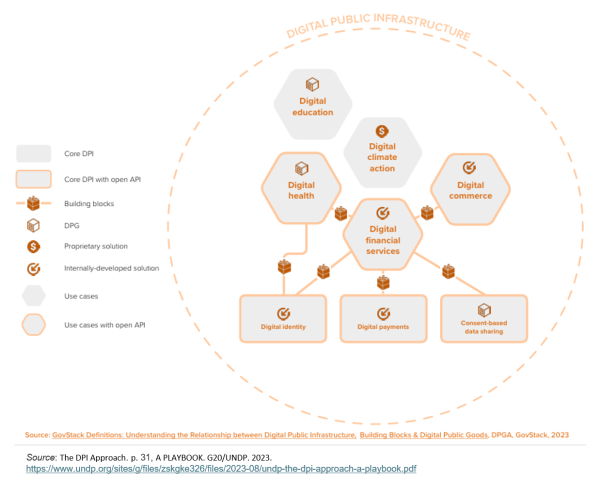
As shown in the following image from the G20/UNDP, to establish the central DPI, countries can choose to use already available digital public goods (DPG), develop their own solution internally, or acquire proprietary solutions. On this basis, they can integrate modular components to develop applications aimed at specific sectors, such as healthcare, agriculture, etc. Application programming interfaces (APIs) and, through them, achieve social outcomes for development [12].
Although that practical guide makes no explicit reference to this, the technologies and resources for developing digital systems and applications, both for the DPI and the previous framework, are all classics.
As strong as this may sound, the traditional technologies of today’s DPI are not capable of providing the necessary capacity to ensure scalability, the processing of complex information within feasible timeframes for many services, and the guarantees of maximum security required for a fully digital society.
With traditional technologies, as is being demonstrated in everyday practice, progress can be made toward digitization, but, without a doubt, this will only apply to digital public services that are less sensitive to the need for maximum security, to the complexity and volume of information to be processed, and to extreme privacy, and provided that, as has always been the case in classical computing, the limitations of classical hardware can be “overcome” with creative, albeit time-limited, solutions. The longer this situation persists, the more evident these limitations and the obstacles they impose on the pace of development and growth of digitization, including digital democracy, will become.
It would be a mistake to reduce the integration of quantum technologies with DPI systems and platforms to their contribution to post-quantum security. That this is the most urgent issue, as we have shown earlier, in no way means it is the only thing that can and should be done in the technological hybridization of classical DPI systems with new quantum solutions. On the contrary, fortunately, quantum technologies already exist which, although very recent and still in the early stages of development and practical application, will overcome the limitations of the aforementioned classical technologies and help enrich the range of services and applications currently unfeasible, making them available to DPI.
Another piece of good news is that quantum technologies in general, and quantum computing in particular, will not replace all the digital systems and platforms of classical DPI. In accordance with the principles of DPI (summarized in the image below), quantum technologies will make it possible to expand the portfolio with solutions that are unfeasible using classical technologies, and they will also complement existing systems and platforms with new capabilities and specialized services. Furthermore, they will be essential for the resilient growth of DPI in the face of the now undeniable threats posed by quantum computing to classical computer systems.
It is very important that we envision the DPI, just as we must do with other classical computing systems handling large volumes of variables, data, and information, on its inevitable path toward classical/quantum hybrid systems. The DPI must, sooner rather than later, begin working toward this goal: defining a hybridization strategy, forming teams, and conducting proof-of-concept tests, among other steps.
To enable the hybridization of the DPI’s classical systems and platforms with quantum systems and solutions, thereby making it possible to use quantum algorithms in the public interest, the process must add a quantum CORE layer to the DPI’s central classical CORE. In the early stages of developing and integrating this hybridization, we will encounter a high-level architecture similar to the one shown in the following image:
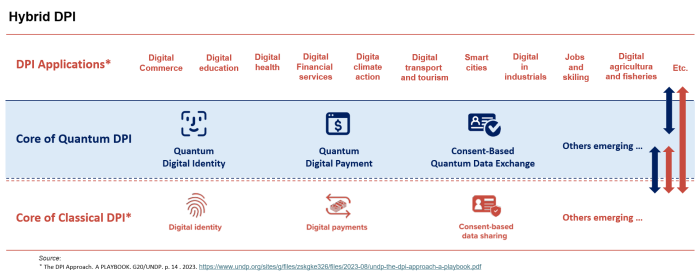
Building on the fundamental principles of classical DPI, this hybrid DPI technology architecture will make it possible to take the following to a new level of quality:
· Interoperability, modularity and extensibility, scalability, and, especially, security and privacy
· Equity and inclusion to ensure that the benefits of quantum technologies are accessible to the entire community
· Trust and transparency in both the development of a public quantum infrastructure and its services
· Quantum-resistant security and privacy
· The use of quantum technology for a more sustainable future
Quantum technologies, when applied to classical digital public infrastructure (DPI), will also provide new capabilities that will enable digital public services to support:
· Immediate information processing regardless of the number of variables, the volume of data to be processed, or its complexity
· Quantum encryption
· Quantum communications
· Quantum internet
· Quantum identity verification
· Quantum algorithms to optimize public services
· Quantum simulations and analyses
· Quantum randomness to ensure, where required, fair and auditable processes
· Personalized and precision digital services for every citizen
Since it is not our intention to discuss a future straight out of science fiction, the content of this installment is limited to what quantum technologies, even in their current early stage of development, can already contribute to society and digital democracy. Quantum technologies have the capacity to make possible what, until now, has been impossible to achieve with classical technologies. The transformative effect that the inclusion of these technologies will have on the creation of a hybrid DPI could be summarized as follows:
· Resilient digital systems and platforms prepared for current and future cybersecurity threats posed by quantum computing
· State-of-the-art protection of information, digital identity, communications, and digital transactions
· Systems capable of ensuring the security, operability, and integrity of public digital systems and platforms within the framework of the complex relationship between national sovereignty and democracy and global social media networks
· Reliability, privacy, and advanced transparency of digital processes on a societal scale
· Public digital systems and platforms free from falsehoods, misinformation, and manipulated information
· Scalability and efficiency of digital systems and platforms for public services. As is already used to manage service disruptions, network traffic congestion, etc.
· Enhancing the competitiveness of state and government institutions and organizations by enabling them to address the complex socio-economic challenges they face with tools that allow them to analyze, calculate, and measure in real time the various situations public administrations encounter on a daily basis. Furthermore, this capability would be reinforced by the ability to conduct predictive analyses based on real-time simulations of social needs.
· Enhance the credibility of state and government institutions and organizations by providing technological safeguards for the management of sensitive information in democratic institutions, the media, and the economy, thereby increasing the reliability and security of public content and communications [13].
· More equitable, accessible, and reliable digital social services for all citizens, and, above all, services taken to a level that would be unthinkable without quantum computing: personalized and precise. In Europe, these services would help implement, in accordance with its welfare state standards, the best options for assisting the 92.7 million people, more than one in five Europeans (20.9%), who are currently at risk of poverty or social exclusion [14], and prevent that number from rising.
· These types of services will enable the public administration to improve the outcomes of its obligation to uphold citizens’ right to the protection of the rights and freedoms inherent in a democratic state, for all equally, in accordance with the welfare state model.
· Personalized, precision services for society in real time, tailored to the individual characteristics of each citizen, available to all citizens at the time of consultation, something unfeasible with classical computers. For example, a personalized and precision pharmacotherapy service for patients on multiple medications, using quantum algorithms to predict genetically mediated drug interactions. This is so complex that not even the world’s most powerful classical supercomputer could process it within a reasonable timeframe for prescribing medications with the assurance that individual variables are not limited when processed in real time. This service will contribute to improving quality of life, saving lives in hospital emergency situations, and also promoting longevity [15]
· The ability to solve complex real-world problems that are currently intractable for classical computer systems. As major banks already do to optimize investment portfolio risks, classify financial risk, etc.
· Optimization of processes in traditional DPI systems to make them more efficient. Quantum optimization stands out for its ability to solve complex combinatorial problems, bringing about changes that have a widespread impact on operations
· Optimization of public service processes that will not only improve their efficiency but will also lead to a more efficient use of materials, funds, and personnel dedicated to: healthcare services for citizens, transportation, retirement plans, energy, water and waste management, renewable energy, and many other areas.
· Optimize European financial control systems to reduce the increasingly chronic and extremely high levels of tax evasion in the European Union and improve tax collection, a measure essential for mitigating the negative consequences this has for upholding the social contract and, directly, for the effective management of the welfare state, through:
o greater transparency regarding financial wealth, which will help reduce the multibillion-euro tax fraud and tax avoidance in Europe
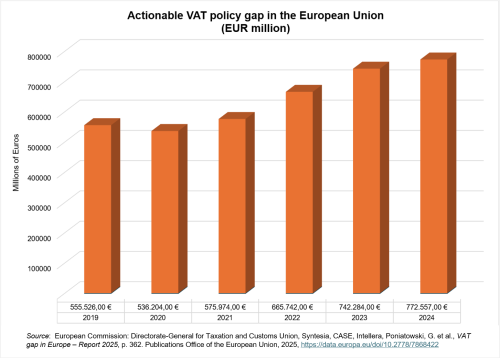
o reducing the EU VAT compliance gap, estimated at 128,000 million euros, or 9.5% of the total VAT tax liability in 2023 [16]
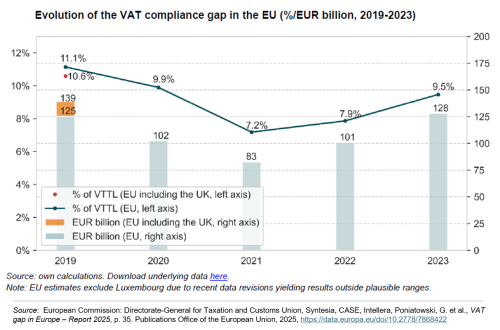
o reduce the growing VAT gap in the EU, estimated at 772,557 million euros in 2024 [17]
· Smart governance with better public administration decisions thanks to much more accurate and up-to-date information. It is already used to schedule staff shifts and other limited resources, plan fleets and routes, manage urban traffic, etc.
· Technologies that will drive science and technology and, through specialized agencies, foster responsible and inclusive innovation applied to economic systems, industrial systems, education and science, climate, and energy, all of which are essential for sustainable development. This is already being done in research on new materials, better medicines, more efficient batteries, etc.
· They will help combat climate change. The greater computational power of quantum computing can assist with tasks as complex as the development of new sustainable materials or new sources of renewable energy [18]
· They will provide digital tools essential for the secure exercise of digital Democracy [19]
· Creation of new jobs: quantum scientists and engineers, software development, applied research, cybersecurity, quantum technology consultants for industry, educators and trainers, etc.
· And a long list of others.
Although it is not formally part of the DPI, an excellent example of what local public administrations can already do to begin putting quantum technologies at the service of society is the BIQAIN (Bizkaia Quantum Advanced Industries) strategy of the Provincial Council of Bizkaia, which, by committing to the knowledge and application of quantum technologies as a lever for social development and the competitiveness of businesses and the region, has designed and implemented a public service to bring quantum computing closer to the people of Bizkaia.
Led by Valentín García, Director of Innovation at Lantik, the project to implement this public strategy aims to “drive and invigorate a specialized, leading ecosystem of competitiveness centered on quantum technologies applicable to industry, where the current ecosystem is integrated and the first frameworks for collaboration are established with technology and industrial companies committed to the use of quantum technologies and the development of innovative projects based on them” [20]. Furthermore, among the key tasks of this strategy is something essential for advancing the adoption of quantum technologies and reducing risks for public services: proactively promoting quantum literacy.
Given the positive track record of results and experiences they are achieving, along with the Lantik team’s excellent commitment to public service, it will only be a matter of time before some of BIQAIN’s current services, as well as some of the solutions developed within this ecosystem, evolve and ultimately become part of the catalog of digital public services that the Biscayan DPI will offer to scientific, educational, technical, and industrial sectors.
As if all that has been stated above regarding the contributions of quantum technologies to the DPI were not enough, these technologies will ensure that digital public services, among which we particularly highlight those essential for digital democracy, play a key role in the strategic race for technological sovereignty and national security.
The future of the DPI’s digital systems and platforms is hybrid, classical and quantum. Thanks to this, the DPI will be able to provide highly competitive solutions and systems, generate new types of digital public services that will help transform traditional sectors of the economy, and also foster the creation of new sectors and activities that will facilitate sustainable development. Through these efforts, the DPI will be able to actively contribute to a resilient quantum digital sovereignty, suited to the complex geopolitical context in which we live, where digitized economies will become increasingly strategic for national security [21].
Environments for the development of quantum software systems and services for DPI
As we have already stated, the future of DPI lies in coexisting with new systems and applications based on quantum technologies. For a long time to come, this will primarily involve integrating existing classical DPI systems and platforms with quantum systems and applications developed to make them more effective.
Obviously, these computing systems can be developed using different platforms, development languages, and tools from various vendors to run on a variety of quantum computers [22], provided they meet one basic condition: they must be a professional solution comprising quantum computing systems and software ready to provide services in the DPI, not merely the development of brilliant quantum algorithms that perform the “magic” in services to citizens. This is because, for quantum software and hybrid systems to be used practically and efficiently by companies, governments, institutions, and organizations within the DPI ecosystem, they must, at a minimum, support:
· Interoperability and integration with the DPI’s digital systems and platforms deployed in production in:
o The cloud
o Open data platforms
o National and local networks
o Local networks
o Digital identity services and other professional services essential for the security of citizen services
· Incorporate security, compliance with standards, procedures, and DPI governance by design
· Apply quantum technologies to the DPI in a practical and enriching way, taking security to a new level and creating digital services that would be unfeasible in the classical technological environment, services that are useful and accessible to all citizens
· Provide solutions that increase and/or create tangible economic and social benefits for society
Rather than providing an extensive overview comparing the features of different environments and platforms for developing quantum software [23], based on our experience in the design, development, and use of one of them, QuantumPath®, we will limit ourselves to highlighting the most notable capabilities of this quantum software development and services environment, as a facilitator for the creation of quantum and/or hybrid digital systems and applications ready for DPI.
QuantumPath® is a quantum software Business Stack platform that supports the professional development and implementation of software and hybrid systems in an engineering-driven, industrial, and controlled manner, as well as quantum software as a service (QSaaS) [24].
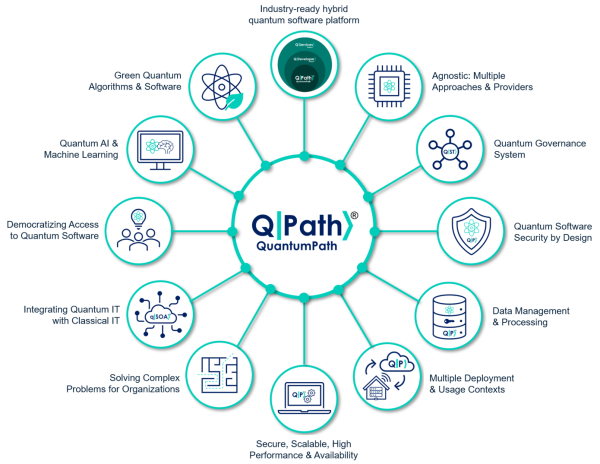
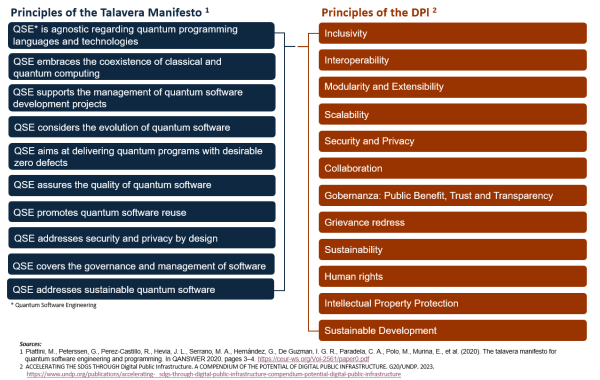
Designed and developed to overcome the major practical challenges of Quantum Software Engineering [25], and in response to the need to facilitate the workforce’s adoption of quantum software development, the creation of this platform has not only applied the principles and commitments related to the field of quantum software engineering and programming outlined in the Talavera Manifesto [26] but, by being implemented by design across its various modules and tools, these principles have been made extensible so that users can apply them implicitly, without extra effort or specialized knowledge, to their quantum and hybrid software development projects and services.
The relevance of this approach for DPI lies in the fact that QuantumPath®, by design, as can be seen in the following image, respects, applies, and promotes principles of good engineering practices for the production of professional quantum software that are equivalent to DPI’s technological principles:
This enables QPath®’s capabilities to provide benefits and opportunities for the development of quantum applications and professional classical/quantum hybrid systems required by the DPI, among which I would highlight:
· It facilitates the application of best practices in quantum software engineering and programming [27].
· ALM to support the entire lifecycle of quantum software and hybrid quantum/classical software systems: from creation, development, testing, integration, and implementation, through to deployment and reuse.
· It provides an environment that allows working with different technological approaches to quantum computers (based on logic gates, annealing, etc.), ensuring the selection of the most appropriate type of computer for each DPI need.
· It employs quantum hardware-agnostic programming, enabling the principle of full software portability: write once, run anywhere. This allows the same algorithm to be executed without having to reprogram it for the quantum computer that best suits the R&D needs in each case. It facilitates the integration of DPI’s classical computing with quantum computing through high-level integration APIs, via the implementation of the qSOA® REST API, which simplifies the development of classical solutions that leverage quantum use cases.
· It resolves most of the quality issues associated with quantum computing platforms [28].
· The Q Assets Compositor® tools support the professional development of scalable quantum algorithms and high-quality quantum software, without requiring knowledge of any specific programming language.
· Supports BizDevOps, which facilitates continuous engineering, ranging from business needs and the development of quantum solutions to their deployment and operation.
· Simplifies the work of quantum software developers through tools that practically help accelerate the training of talent in this field.
· Implements software development and deployment based on the principles of distributed architectures required by the DPI.
· Supports deployment of the platform in multiple contexts [29] so that it can, by design, adapt to different security strategies, IT infrastructures, and DPI business models.
· Features shorter quantum software development cycles that accelerate the delivery of prototypes, PoCs, and software products to the DPI.
· Manages quantum technology risks with Q Risk Management® [30].
· It features a governance system for quantum software ecosystems and hybrid software systems tailored for the centralized management of complex quantum hubs with multiple stakeholders, such as the DPI [31], which integrates:
o A service model: Q|PrivateHub®
o A service management model: Q|MGMTmodel®
o Specialized service governance management software: Q|GovCenter
· A cost-control subsystem that allows for estimating both the cost of running algorithms and protecting the budget through spending limits
· Its architecture is secure, extensible, and high-performance, designed so that both the platform and the solutions developed with it can “keep pace” with the rapid evolution of quantum hardware [32].
· It facilitates the application of best practices in quantum software security engineering.
· It applies principles for the sustainable development of quantum software and hybrid systems.
· The technology of the platform’s CORE module, which enables the engineering and lifecycle management of quantum and hybrid software, is patented [33].
Given the significance of what this platform can contribute to the hybridization of quantum and classical software, an inherent aspect of the future of DPI systems, it is worth delving a bit deeper into the technology that makes this possible: qSOA®.
Designed to integrate the worlds of classical and quantum software through open, robust, and transparent protocols, qSOA® facilitates the development and dynamic integration of hybrid software systems, systems that will be essential for the next technological leap in DPI.
Inspired by the highly robust and proven SOA (Service-Oriented Architecture), qSOA® extends this architecture to quantum services, respecting and applying its design principles to each of the quantum services modeled using it. For this reason, qSOA® stands for Quantum Service-Oriented Architecture.
By extending service-oriented architecture to the quantum domain, “with qSOA® we propose a clear, efficient, concrete, secure, and open-standard architecture for interconnecting classical systems with quantum systems, using familiar systems and software, as well as common tools. A high-level proxy wrapper is provided that allows classical technology to communicate with quantum technology, while keeping the architectural elements, technical complexities, optimizations, translations, mappings, etc., “inside the box” [34].
In accordance with DPI principles, the use of this technology ensures that each service is autonomous and independent of the others, guarantees interoperability through the use of open protocols and standards, and allows for implementation in any of the common programming languages (such as Python, .NET, or JavaScript, to name a few well-known examples, which are currently available as part of the CORE toolset). This will decouple the logic of the classical DPI client from the complexity of quantum hardware, enabling classical DPI software to utilize quantum optimization or simulation algorithms in a fully transparent manner. And all of this with minimal disruption to existing classical digital systems and platforms.
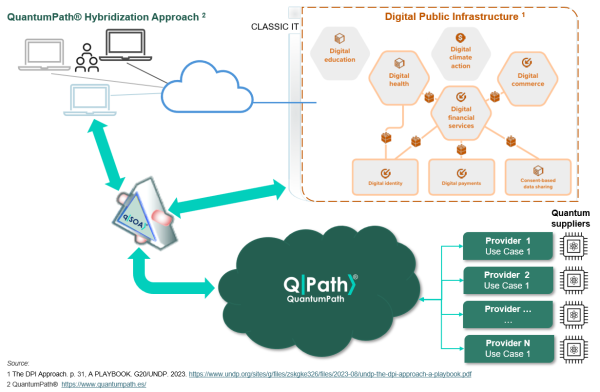
The following image provides an overview, through the high-level architecture, of the potential integration of QuantumPath® with qSOA® technology services, CORE systems, and DPI digital platforms (using the elements of the DPI architecture [35], to which new modules will be added over time, such as the one on Digital democracy and its future applications), through which the classical requests from each would be translated into pre-processed instructions so that the quantum infrastructure can understand them and return the post-processed result to the classical environment.
Some Possible Hybrid Solutions with QuantumPath® for DPI
Certain quantum verticals developed with QuantumPath® can be used to practically implement hybrid solutions. These solutions leverage QuantumPath®’s quantum computing technologies, particularly its agnostic, hybrid capabilities via standards-based APIs. These APIs integrate quantum applications with existing IT infrastructure. This provides valid and scalable practical experience for developing other quantum solutions that are truly ready for the DPI ecosystem.
To illustrate QuantumPath®’s capabilities for hybridizing DPI systems and platforms with quantum technologies, we present two examples involving quantum gates and annealing, using qSOA®’s open protocol-based tools:
· Security: The QRNG (quantum random number generation) algorithm
· Optimization: The scheduling of appointments for citizens
The QRNG (Quantum Random Number Generation) Algorithm:
This solution utilizes a QuantumPath® system, which is designed and implemented to provide random numbers as required. QRNGs are the fundamental basis for many current algorithms, such as key generators for encryption algorithms, two-factor authentication tokens, etc., and integrate this random number into an encryption process where such data is critical to security.
These capabilities, which the platform makes available to quantum software development teams and hybrid software systems, along with the references provided to learn more about them, should be sufficient to briefly demonstrate its technological and management potential for developing DPI-ready classical/quantum hybrid systems.
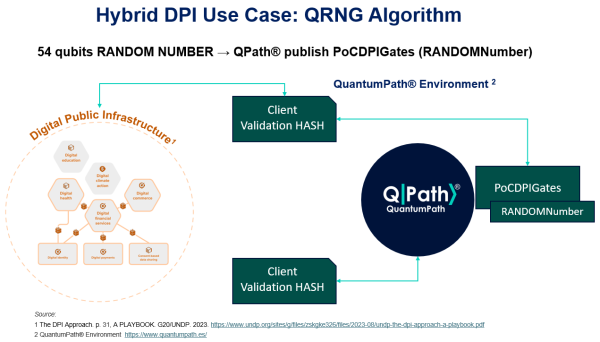
This QPath® vertical solution allows for the integration of this highly secure random number into any encryption process that requires such data, using tools based on open protocols. It can also be used in any available two-factor authentication process, thereby elevating the security of the process to which it is applied to the highest possible level: the quantum level.
The scheduling of appointments for citizens
This solution facilitates the implementation of an appointment scheduling algorithm. By defining the variables to be considered, a system is designed to generate specific, optimal scheduling options that can be established and/or updated in real time. We believe this solution is particularly useful for maximizing the efficiency of citizen appointment management and, thereby, avoiding wasted time blocks or the underutilization of limited and costly physical spaces (such as operating rooms). Consequently, this results in more agile management of the scheduling process, cost savings through maximized utilization, and satisfied citizens due to shorter wait times.
The quantum application’s design, when integrated with this solution, enables dynamic request processing and result retrieval using tools based on open protocols.
This approach enables the seamless integration of quantum-optimized content within a web-based calendar, facilitating a seamless transition between traditional and quantum-optimized operations.
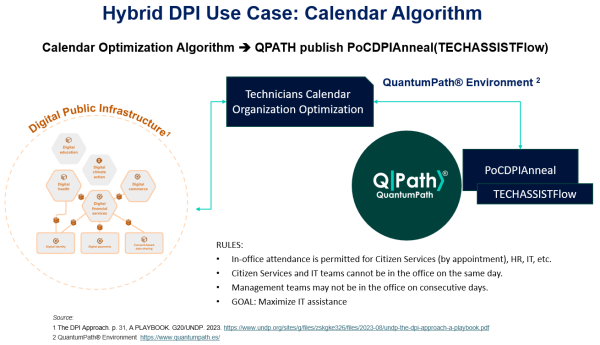
These quantum applications can be implemented using as many valid use cases of classical DPI digital systems and platforms as necessary. The integration process is highly specific, configurable, and controlled, featuring a coherent and comprehensive “industrial” information system that encompasses the entire process. This system creates the necessary abstraction layer to isolate quantum services under high-level “classical” interfaces, using the minimum number of lines of code required.
Beyond the value that implementing these advantageous solutions can bring to administrative operations and adding quantum security to access to classical digital systems and platforms, it is also useful for experimenting, taking the first steps, and conducting proof-of-concept tests in hybridization, and, gradually, planning for the adoption of practical quantum computing by the DPI, beyond the test itself. For this reason, we believe it is important to highlight that these hybrid solutions, no matter how “simple” they may seem, offer the DPI the following:
· this platform boasts a broad spectrum of applicability within the public administration sector
· a high likelihood of extension to multiple real-world applications for both internal services and the public sector
The capabilities that this platform offers to quantum software development teams and hybrid software systems, along with the references provided for further information on these capabilities, should be sufficient to briefly demonstrate its technological and management potential for developing classical/quantum hybrid systems ready for DPI.
The Public Quantum Infrastructure
In this overview of the technologies provided by QuantumPath® for DPI, we cannot fail to highlight the governance module. In particular, its capabilities for managing hubs and, even more so, controlling costs within them. For DPI, it is essential to be able to clearly establish scope and cost contexts. Given the need to align budgets with specifications and the strict cost-control model of public administrations, it is critical not only to provide a robust, secure, and compatible technological platform, but also one that is governable and controlled in all its manageable aspects.
The Concept of a Quantum Hub
A Quantum Hub can be defined as a technology intermediary platform that connects users, applications, and algorithms with multiple underlying quantum resources.
Its function is not limited to providing access to quantum computers, but also includes the following capabilities:
· Resource discovery.
· Workload orchestration.
· Cost optimization.
· Access governance.
· Consumption monitoring.
· Interoperability assurance.
From the DPI’s perspective, a Quantum Hub functions similarly to a shared public infrastructure that democratizes access to highly specialized resources. Therefore, with technologies such as those proposed by QuantumPath®, it is possible to provide both foundational technology to government organizations and, in a more targeted manner, support to individual organizations for their local projects or supply chains.
Cost Management as a Strategic Challenge.
One of the main obstacles to the adoption of quantum technologies is cost.
Unlike traditional computing, in quantum environments, cost depends on multiple variables:
· Number of qubits required.
· Circuit depth.
· Runtime.
· Level of error correction.
· Access priority.
· Type of technology used.
Without advanced management mechanisms, there is a significant risk of inefficient use of public resources. This poses exactly the same problem as the use of cloud resources in the public sector: how can spending be controlled when using external resources on demand and in real time?
Thanks to the design of the QuantumPath® CORE, it is possible to measure and control these parameters, even if only approximately. And thanks to HUB technologies, it is possible to manage pricing and consumption costs for quantum devices in each implemented project.
This provides a hub management platform that will enable:
· Automatic optimization
Selecting the most suitable quantum provider for a given workload.
· Quantum “FinOps”
· Apply principles similar to Cloud FinOps to:
o Budget control.
o Cost allocation.
o Consumption forecasting.
o Return on investment analysis.
· Financial Governance
Enable public administrations and agencies to define usage policies, budget limits, and prioritization criteria.
· Transparency
Public administration requires traceability and auditability.
Management platforms allow for the logging of access, routing decisions, and resource utilization.
All of the points we’ve discussed ultimately provide benefits for the public sector. Incorporating quantum hub management platforms into a DPI strategy yields direct benefits:
· Optimization of public investment
Avoids duplication of specialized infrastructure.
· Democratization of advanced capabilities
Enables small entities to access quantum capabilities without prohibitive investments.
· Technological sovereignty
Facilitates the development of national and European quantum computing ecosystems.
· Acceleration of innovation
Universities, companies, and technology centers can share resources efficiently.
· Development of ecosystems
Fosters the emergence of communities, Marketplaces, and new models of public-private collaboration.
Toward a Quantum Public Infrastructure
As quantum computing evolves toward production environments, it will no longer be sufficient to consider only hardware as a strategic element.
The true value will lie in the ability to coordinate, share, and optimize quantum resources on a national and international scale.
Just as the internet required open protocols and cloud computing required management platforms, quantum computing will need coordination infrastructures that enable scarce and costly resources to be transformed into services accessible to all of society.
This scenario leads to a new concept: Quantum Public Infrastructure (QPI), where quantum hubs act as mechanisms for access, governance, and optimization to ensure that quantum capabilities become a digital public good and not exclusively a competitive advantage for a select few actors.
Quantum hub management platforms should not be viewed solely as operational tools for technological administration. They constitute a strategic layer of the Digital Public Infrastructure that provides interoperability, economic efficiency, governance, and democratization of access.
As quantum computing becomes a critical resource for economic competitiveness and scientific innovation, the ability to intelligently manage the costs and access to these resources will be just as important as the available computing power itself. Therefore, quantum hub managers are poised to become a fundamental part of the next generation of digital public infrastructure.
Of course, QuantumPath® is not a “panacea” for the complex development of quantum software. However, it provides development teams with best practices in quantum software engineering in an integrated and assisted manner, enabling the development and implementation of hybrid software systems in an engineered, industrial, and controlled way. This helps raise the bar for productivity, quality, and efficiency in the production, deployment, and operation of the next generations of DPI’s hybrid quantum/classical software systems, and also enables the delivery of professional public services that reliably leverage this new generation of hybrid computing solutions.
Quantum Technologies and Digital Democracy
The history of democracy, as an inseparable part of humanity’s social progress, has never been linear. Typically, periods of progress have been followed by setbacks and counter-reforms, some of which have lasted for a very long time. In a highly condensed form (with the risk of omissions that this entails), we could outline the major milestones of democracy, from its emergence in classical Greece and the Roman republic to the present day, as follows:
· the very long “historical hiatus” that the period of absolute political power wielded by monarchies, feudalism, and the Church during the Middle Ages represented for democracy, which eradicated it as a form of government
· the emergence, beginning in the 18th century, of the ideas of modern democracy
· the establishment of representative democracy around the world with the Declaration of Rights of 1689 (Bill of Rights 1689) in England, The Constitution of the United States of America of 1787 (The Constitution of the United States), and the Declaration of the Rights of Man and of the Citizen of 1789 (Déclaration des droits de l’homme et du citoyen de 1789) in France
· the achievement of universal suffrage, beginning with its introduction in New Zealand in 1893 [36], and continuing through the first half of the 20th century
· the setbacks to democracy worldwide in the first half of the 20th century due to the rise of dictatorships of various ideologies that abolished democracy throughout virtually all of Europe
· the expansion of representative democracy first after World War II and then, following the collapse of the colonial system, driven by the UN’s Universal Declaration of Human Rights (Universal Declaration of Human Rights) in 1948
· the sustained trend toward the weakening of democracy on a global scale so far in the 21st century, as shown by the indicators presented in the first article of this trilogy [37].
The statistical data presented in the first installment shows that, on a global scale, democracy is in crisis. But when discussing the current crisis of democracy, we must be as precise as possible, because the trend these indicators actually reveal is, above all, the exhaustion of the dominant model of democracy since the mid-20th century: representative democracy.
We have no doubt that representative democracy, beyond the inherent limitations that characterize it, has been very useful for the progress of humanity since the 20th century, but all signs indicate that, as it stands and given the direction it has been steadily heading in recent years, it cannot go much further without being reformulated.
This crisis of representative democracy is of such magnitude that attempting to continue with this model of democracy without urgent and significant changes will risk playing into the hands of its opponents and allowing them to continue gaining ground, as they have been doing in recent years. Let us recall that, as a result of its sustained decline over more than 20 years, by 2025 the world had fewer democracies than other types of government systems: only 74 countries worldwide were democratic (31 of them in Europe) and 93 were non-democratic (only 5 of them in Europe) [38].
The current state of representative democracy in the countries of North America and Western Europe, and especially the trend observed in recent years, as analyzed in the 10th edition of the V_Dem Democracy Report [39], regions that have historically been home to its finest examples, is a factor that must not be overlooked amid the increasingly urgent calls for reforming representative democracy.
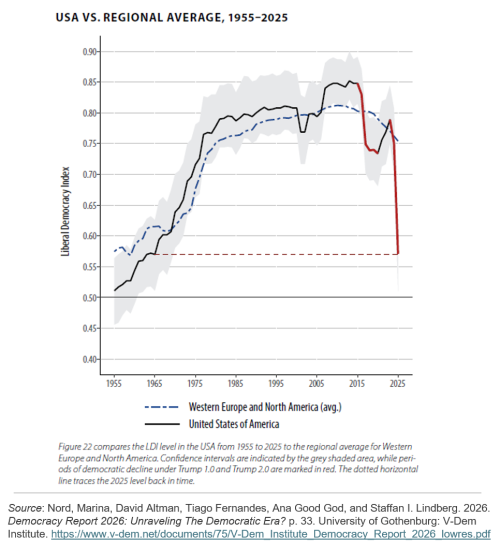
The report highlights the rapid deterioration of representative democracy in the United States, where the Liberal Democracy Index (LDI) has declined by 24% in just one year, and its ranking on the global index (among 179 countries) has fallen from 20th to 51st. According to the report, this process is characterized, among other factors, by:
· The fastest expansion of executive power in modern history
· The concentration of power and the dismantling of checks and balances
· The transfer of powers from Congress to the President
· The removal of restrictions on the executive branch
· Contempt for the judiciary and the erosion of the rule of law
· The dismantling of civil rights and equality before the law
· Attempts to silence the media, dissenting voices, and the academic community
· Acts of repression against free associations
· Increased pressure on civil society
As a result, the rapid decline in these indicators shows that the level of democracy in the United States has regressed to levels comparable to those of 1965. As a result of this deterioration, according to this report, the United States has lost, for the first time in more than 50 years, its status as a “liberal democracy” and has come to be classified as an “electoral democracy.”
In the case of the European Union, although fortunately at different levels and paces, this graph also shows a deterioration in the indicators of the health of representative democracy in recent years, compounded by the rise of authoritarianism as a political option. Nevertheless, the political and technological conditions still exist to strengthen representative democracy, not only by expanding and improving traditional participatory spaces but also by endowing them with greater decision-making capacity and binding outcomes, thereby taking existing spaces to a new level, such as:
· European Civil Society Platform
· Dialogue Forums on Trade Agreements
· European Citizens’ Initiative (ECI) [40]
To leave no doubt about the need for improvements to representative democracy in the European Union, one need only look at the number of EU countries that do not rank among the top 15–20 in the equality (ECI), participation (PCI), and deliberation (DCI) components of democracy in the V-Dem 2026 report [41].
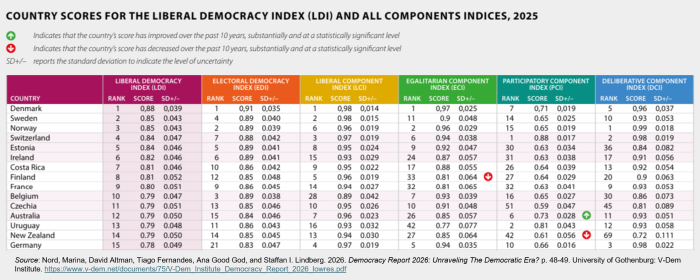
Furthermore, to strengthen representative democracy through the digitization of democracy, legal mechanisms should be conceived, designed, and implemented to hold referendums at the national leve, beyond the existing ones for the ratification of treaties and for accession to and withdrawal from the European Union. The Union should also be granted the necessary constitutional powers to organize and hold this type of direct consultation.
If this situation makes one thing clear, it is that democracy is not a given that, once established, lasts forever. Its survival requires a constant effort to enrich it, refine it, and make it useful by demonstrating its value in everyday practice, ensuring that its fundamental principles are consistently upheld, as it serves as the primary safeguard of equality and progress [42].
nd truth be told, the constant accumulation of errors, apathy, negligence, abuse of power, and even betrayals of the fundamental principles of democracy by the representatives of the representative democratic system (parties and politicians) over the past 20 years has done little to fulfill that role in society. This is clearly evident in the state of the key indicators of representative democracy (corruption, the administration of justice, citizen participation, and civil liberties), both at the national and global levels. All of this has led to a deep sense of frustration and disillusionment among millions of people and has negatively impacted the credibility of the democratic system.
Another factor that must not be overlooked among the causes of the urgent need to reform representative democracy is the unprecedented, extremely rapid, and massive accumulation and centralization of wealth, which shows a clear upward trend, that has occurred among a very small group of individuals (as well as corporations [43], over the past 20 years. These figures illustrate the incredible pace of this growth:
· In 2006, only three people in the world had a personal fortune estimated to be between 30,000 million and 50,000 million U.S. dollars, the highest figure for that year [44]
· In contrast, in 2026:
o more than 120 people worldwide (the number fluctuates depending on the value of their stocks) have a net worth exceeding 50,000 million US dollars [45]
o more than twenty people worldwide have a net worth exceeding 100,000 million US dollars, known as centi-billionaires (billionaires in English), among whom those involved in new technologies (and who are growing the fastest), communications, and the luxury goods industry stand out [46]
o Between six and eight people (depending on the valuation of their shares) have a fortune exceeding 200,000 million U.S. dollars (all linked to new technologies) [47]
o there is already one person with a personal fortune exceeding 1,000,000,000,000 U.S. dollars (on the short, Anglo-Saxon scale), which has given rise to a new category of ultra-wealthy individuals: the trillionaires, a group expected to grow to 13–14 people over the next decade
§ If we use the IMF’s projections as a reference, by 2026 this level of wealth will exceed the annual GDP of 174 countries worldwide; that year, only 21 economies worldwide are projected to generate more than 1 trillion U.S. dollars in GDP [48]
o Each of the largest individual fortunes among centi-billionaires (on its own) accounts for between 0.08% and 0.37% of the world’s total net worth [49]
o The world’s 10 richest billionaires hold more wealth than the poorest half of humanity, that is, more than 4 billion people [50]
It stands to reason that an economic power of such magnitude will demand other forms of power that allow it, either directly or through handpicked and/or well-funded representatives, to gain access to a political system that is subordinate to it or, in the worst-case scenario for them, one that does not hinder its personal objectives and interests. As much as it may seem so, this is far from being a dystopian vision of society. One need only follow the reports published by the world’s most prominent and respected media outlets to see, day after day, that this is already happening, and that this news trend is openly eroding democracy in many of the world’s democratic countries. Proof of this is the recent public coalition of the ultra-wealthy in the United States to influence the outcome of the latest presidential and congressional elections in favor of whoever offers the greatest advantages to their businesses.
The current situation regarding donations from the ultra-wealthy to political parties varies significantly by country and region: in the United States, the rules in this regard are much more permissive (the Supreme Court has been ruling for several years in favor of reducing restrictions on the power of big money in American politics; the most recent of these rulings is from this year [51]). To verify this, one need only consult OpenSecrets’ data on the most recent presidential and congressional elections [52], and the strong trend toward changes in the behavior of major donors [53]; whereas in European Union countries, the regulations are more restrictive (in fact, in November 2026, legislative changes were made to increase oversight in this area [54].
Of course, we are not the only ones who see this risk; so do most of the 3,900 millionaires residing in G20 member countries surveyed by Survation on behalf of Patriotic Millionaires [55] who, among other things, responded as follows:
- 62 percent believe that extreme wealth is a threat to democracy.
- 81 percent believe that extremely wealthy individuals can gain access to politicians through their wealth.
- 77 percent believe that extremely wealthy individuals buy political influence.
- 61 percent believe that our political leaders should do more to combat extreme wealth.
- 62 percent believe that extreme wealth is detrimental to social trust.
We must prevent this disturbing reality from leading to a breakdown of the social contract in a democratic state, which is the foundation of social progress. It is not a bad idea, as Zucman suggests [56], to consider that “It is time to complete what we began in the late 19th and early 20th centuries with the income tax, a major step forward for democracy. The time has come to finally bring billionaires, who have never truly been subject to this tax, into the system. Completing this unfinished revolution is imperative if we are to uphold our fundamental principles of equality before the law.” The problem with this proposal is that establishing a minimum tax for individuals with ultra-high net worth, and ensuring it is enforced, while preventing it from becoming a political maneuvering exercise, is practically impossible unless democracy is strengthened with mechanisms that compel politicians to give this issue the priority it deserves and sustain that commitment over time. And that is part of the battle to strengthen democracy.
Another risk factor and source of added pressure on representative democracy today is the emergence of a new world (dis)order, in which there is a growing trend toward abandoning the rules and principles of democratic coexistence among states. principles that underpin peace and development. Some governments, which, paradoxically, are part of states defined as democratic, are calling for the replacement of these principles with the law of the strongest and for the recognition, and even support, of undemocratic systems of government. As part of this process, policies of harassment and dismantling are being applied to the organizations and institutions tasked with safeguarding the civilized and peaceful coexistence of nations in accordance with democratic values, and an even more aggressive stance is being taken against those charged, by collective mandate, with ensuring the application of international justice.
Given how representative democracy is defined and established, and paying special attention to the fundamental causes of its crisis of credibility and value, it is reasonable to doubt whether it is prepared to manage these situations and enforce the fundamental principles of democracy for the common good of the majority of society. These risks can only be mitigated if representative democracy is profoundly strengthened by capitalizing on some of the opportunities that digital democracy offers for this purpose, not through rhetoric and political maneuvering.
The current historical evolution of democracy, in light of the general trends toward the increasingly widespread digitization of society, is showing the first signs of promising progress with the emergence of public digital services that will make possible, first, the emergence of tools and elements of digital democracy and, on that basis, the establishment of broader forms of participatory and direct digital democracy.
Digital democracy is one of the most commonly used terms today to refer to what has also been described, in its recent evolution [57], as electronic democracy or e-democracy, virtual democracy, Internet democracy, cyberdemocracy [58], etc., it utilizes ICT (information and communication technologies) for political processes and the governance of society. Many of these are closely linked, above all, to elections (e-elections), voting (e-voting), and participation (e-participation).
In the year 2000, when the talk was mainly of electronic democracy or cyberdemocracy; when the Internet operated on the Web 1.0 model; the year of the dot-com bubble and the birth of e-Government, Hacker and van Dijk defined digital democracy as “a set of attempts to practice democracy without the constraints of time, space, and other physical conditions, using ICT or CMC (computer-mediated communication) instead, as a complement, not as a replacement for ‘analog’ traditional political practices” [59].
In 2012, a year when the internet operated under the Web 2.0 model, mobility had taken off, and social media was beginning to expand, van Dijk updated his definition of digital democracy “as the pursuit and practice of democracy, from any perspective, through the use of digital media in political communication, both online and offline. It is necessary to add the distinction between ‘online’ and ‘offline’ because political activities take place not only on the Internet but also at in-person meetings where mobile digital devices are used as support” [60].
In 2026, with the Web 3.0 internet technology model in transition toward Web 4.0; given the high level of digitization and public services achieved by the DPI; the deep convergence of state institutions and politics with ICTs; a definition of digital democracy, as presented in this article, could be: the digitization of today’s democracy encompasses all processes related to democracy, not just certain parts of it, until a fully realized, mature, participatory, and direct digital democracy is achieved.
In this approach, digital democracy is conceived as just as real as in-person democracy, as two parts of a whole that, taken together, will first strengthen representative democracy; and this, as it evolves and is refined, will move toward a more complete democracy, free from limitations or excessive and unnecessary filters that hinder society’s true interests.
To achieve a fully-fledged digital democracy, the progressive digitization of democracy must encompass, at a minimum:
· the structure of the system (the electorate, political parties, elected representatives, the Constitution)
· the branches of government (Legislative, Executive, and Judicial), ensuring the absolute independence, security, and privacy of each
· the processes corresponding to the fundamental categories of democratic governance (representation, rights, the rule of law, and participation),
· the impact of the quality of management of each of these processes on indicators of the quality of democracy (corruption, the administration of justice, citizen participation, and civil liberties).
· the digitization of democracy will open new avenues for transparency in democratic governance, enable effective curbs on poor administrative practices, and reduce the scourge of anonymous accountability.
In the current technological context, the limited applications of digital democracy already provide benefits to the democratic system as a whole by:
· Bringing representatives closer to citizens, streamlining information and communication between them, something essential in the current state of democracy
· Simplifying access to information and transparency by making them available to everyone
· Overcoming the obstacles often posed by venue capacity, schedules, geographic distance, travel, etc., which typically hinder participation
· Reducing the costs and administrative time involved in any process, including consultations, debates, and elections
· Expand the diversity of participants and forums for direct debate
· Provide tools and mechanisms so that accountability to citizens becomes an almost daily practice
Of course, the digitization of democracy also entails risks that must under no circumstances be overlooked, among which the following stand out:
· Naively believing that simply digitizing state institutions is enough to perfect the democratic state’s system of political and social organization.
The reality is that this possibility, as we are currently seeing, also applies to authoritarian forms of state organization (including digital fascism [61]). Totalitarian states will use quantum technologies to strengthen their structures, increase control, curtail freedoms, and,m let there be no doubt, also to attack other states.
· Failing to create the conditions so that all citizens, who are of legal age and have the rights to exercise democracy, can do so regardless of age, race, creed, technological skills, etc.
· Failing to establish and enforce strict security policies that prevent identity theft and the manipulation of votes and any participatory activity.
· Failing to implement and rigorously enforce active policies that prevent public service systems and platforms from being used for undemocratic purposes and practices such as aggression, exclusion, the spread of fake news, and the polarization of society.
The opportunities presented by digital democracy are so vital to the essential strengthening of democracy that we must avoid making significant mistakes in the process of its development and implementation. In this complex process, we must avoid, driven by enthusiasm, haste, and both good and bad intentions, implementing systems and platforms for digital democracy that do not offer the technological safeguards essential to ensure that it is as secure, or even more so if possible, than the democracy we know in the physical world. The technological and managerial rigor of the DPI must be decisive in this regard.
As we saw in the second installment of this trilogy [62], since we are discussing digital democracy, simply digitizing the required services using current conventional technologies will not be enough for this trend to take hold. This digitization must be based on a different technology, one that is quantum-resistant. To this end, as we saw in the previous sections of this article, the DPI will be able to offer digital democracy a robust technological environment, with quantum-resistant security, that forms part of a public digital ecosystem featuring hybrid, classical/quantum systems and platforms.
Bearing in mind the history of democracy and the decisive role of politics in its forms and mechanisms, in order to move toward a participatory and direct digital democracy with safeguards, digital public services will be required to provide extraordinary evidence of compliance with certain technological, governance, and community principles of the DPI [63], particularly the following:
· Inclusivity
· Interoperability
· Modularity and extensibility
· Scalability
· Security and privacy
· Collaboration
· Governance in the public interest, fostering trust and transparency
Just as with the digital systems and platforms of digital public services from a technological perspective, quantum technologies also present direct challenges, risks, and benefits for digital democracy.
In addition to the risks to digital democracy listed above, quantum technologies add, at a minimum, the following risks that are currently more evident:
· The ability to break current cryptographic systems and its implications for vulnerabilities in:
o the encryption protecting the electoral system and government communications
o the digital identities of officials, representatives, citizens, etc.
· The potential to decrypt the critical infrastructure used for elections and government communications regarding the results
· Compromising the “complexity shields” that have thus far been used to protect electoral systems from attempts by various actors to influence election results through electoral manipulation and computational social engineering [64]
· The ability to process big data at quantum speeds to enhance systems for mass surveillance of citizens [65]
· The dangers to human rights posed by the absence of effective policies to prevent the misuse of quantum technologies [66]
· The widening technological divide and the dangers of increased exclusion and concentration of power to the detriment of democratic principles
· The negative repercussions that the growing role of quantum technologies in matters of national security, technological sovereignty, and military applications could have on quantum security and adherence to democratic principles
But let us not be alarmist, and let us not delude ourselves regarding the actual scope of the risks that quantum technologies pose to representative democracy in general, and digital democracy in particular. First, because, as we saw in the section Hybrid Classical/Quantum DPI for Digital Democracy, the risks and threats posed by quantum technologies can be mitigated through the appropriate and controlled use of quantum computing. And second, because the threats to representative democracy posed by the alarming state of its indicators, corruption, justice, citizen participation, and civil liberties, are already a risk “as complex to mitigate” as those that quantum technologies might pose to digital democracy.Quantum technologies also offer the following benefits specific to digital democracy:
· Quantum security will encourage participation in digital democratic life (access to information, voting, referendums, petitions, debates, etc.) through public digital systems and platforms, networks, and so on.
· Quantum-resistant security and reliability of the identification and privacy of every public official, representative, citizen, etc.
· Security and reliability of the digital vote verification system, ensuring voting secrecy and preventing vote tampering
· Security and reliability of the communication channels used by state and government institutions
· Algorithms and solutions to ensure:
o that communications within the digital democratic system are secure and quantum-computing-resistant
o the existence of a unique digital identity document, more secure than the passport we use to identify ourselves in the digital society
o the exercise of participatory digital democracy without the risk of identity theft
o ensuring that digital public services are free from falsehoods, fake news and manipulation as a political principle—scourges that artificial intelligence has exacerbated on social media
o eradicating the anomaly that hinders digital democratic coexistence and the major obstacle to the growth of a digital society: the de facto prevalence on the internet of the “law of the jungle” or the “Wild West”
· The possibility of optimizing the management of state and government institutions and creating new digital public services for digital democracy.
In the case of Europe, for example, quantum computing could help optimize the good idea behind the 2012 introduction of the European Citizens’ Initiative (ECI), at the time, a new way for citizens to express their opinions on European Union policies. However, because this participatory mechanism is not widely known, its entire process is cumbersome, it takes too long for citizens to engage with it, and it has a low success rate (as shown in the image below), there is little incentive to use it. It is estimated that, on average, it takes more than 50 months (just over 4 years) from the time an ECI is initially registered [67] for a successful ECI to result in tangible legislative action.
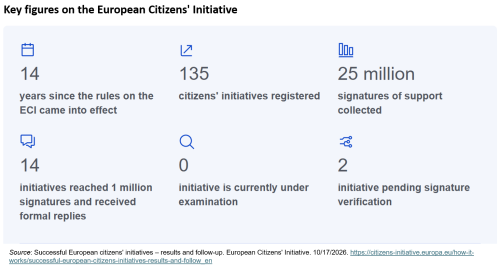
Quantum technologies will help solve complex challenges that are intractable for classical systems, enable the creation of digital public services that are unfeasible with classical computing technologies, and mitigate security risks and those associated with digital platforms in the DPI. Public services based on hybrid technologies will empower citizens and, in particular, vulnerable populations.
The pace of development of the DPI largely depends on the political will to allocate the resources necessary to transform the ways in which political power is exercised in a digital society. For obvious reasons, this dependence is much greater when it comes to investing in costly systems and platforms to transform democracy and enable full digital democracy based on quantum technologies. And this is even more true when it comes to investing to enable democracy to advance toward participatory and direct digital democracy.
Summary
Quantum technologies are set to transform the digitisation of society based on classical computing. When incorporated into the DPI in a responsible manner, these disruptive technologies will contribute to the development of digital societies that are more secure, efficient, inclusive, resilient, and democratic.
Quantum technologies will enhance and reinforce the current DPI by integrating with classical systems and platforms; they will not replace them. This approach is the most effective strategy for enhancing citizens’ trust in the digital society and, in turn, promoting sustainable development. This is not a significant issue.
As part of the ongoing development and maturation of digital society, quantum technologies will provide digital democracy with reliable and effective tools, thereby ensuring its viability and helping to reverse the decline of today’s democracy. Many of these contributions to digital democracy will help to undermine the main arguments and justifications historically used to defend the status quo of democratic forms.
Despite their relative youth, quantum technologies already provide commercial platforms and solutions for the development of quantum and hybrid digital systems and platforms. These technologies can serve as catalysts for the adoption of these technologies by the DPI.
Quantum hubs specialising in DPI services will give rise to the concept of Quantum Public Infrastructure (QPI), where quantum capabilities will also become a public good. Given the need to protect information with urgency, the first area of convergence between quantum and classical technologies in the DPI is cybersecurity. It is vital that all systems are protected, with priority given to the digital infrastructure of critical services.
It is essential and urgent to define a strategy and plans to begin working on the implementation of quantum-resistant security. The deployment of post-quantum cybersecurity measures is imperative to mitigate the threat posed to the cybersecurity of the DPI’s digital systems and platforms by quantum technology. Those who have not yet initiated work on this are already at risk of experiencing inadequate security for their computer systems.
Digital democracy, based on hybrid digital systems and platforms, combining classical and quantum technologies, from the DPI, will make it possible to update and enrich democracy with new ways of practising participatory digital democracy, making it more robust, broader, and more inclusive. For these reasons, we believe that the future of democracy, from a technological standpoint, is digital and quantum.
[1] Peterssen, G. Democracy & Quantum Technologies (II). The current state of Digital Public Infrastructure (DPI). The QPath® Blog. October 2026. https://www.quantumpath.es/2026/10/05/democracy-quantum-technologies-ii-the-current-state-of-digital-public-infrastructure-dpi/
[2] Schuster, T. Kufel, D. Yao, N.Y. Huang, H.Y. Hardness of recognizing phases of matter. rXiv:2510.08503v2 [quant-ph] 17 Mar 2026. https://arxiv.org/pdf/2510.08503
[3] Chhetri, G., Somvanshi, S., Hebli, P., Brotee, S., & Das, S. (2025). Post-quantum cryptography and quantum-safe security: A comprehensive survey. arXiv preprint arXiv:2510.10436.
[4] World Economic Forum. Quantum Computing Governance Principles, 19 January 2022, https://www3.weforum.org/docs/WEF_Quantum_Computing_2022.pdf
[5] Peterssen, Guido, “Quantum Technology Impact: The Necessary Workforce for Developing Quantum Software,” in QANSWER, 2020, pp. 6-22. https://ceur-ws.org/Vol-2561/paper1.pdf
[6] Hevia, J.L. Peterssen, G. Piattini, M. Quantum software development risks. Quantum Information and Computation, Vol. 24, No.5&6 (2024) 0455-0467. Rinton Press. https://www.rintonpress.com/xxqic24/qic-24-56/0455-0467.pdf
[7] Suter V, Pöhlmann G, Ma C, Meckel M. Quantum technologies and geopolitics: comparing parliamentary rhetoric. EPJ Quantum Technol. 2026;13(1):10. doi: 10.1140/epjqt/s40507-025-00456-w. Epub 2025 Dec 19. PMID: 41585067; PMCID: PMC12830432. https://pmc.ncbi.nlm.nih.gov/articles/PMC12830432/
[8] Ivezic, M. Dutch Quantum Strategy Says Prepare for Q-Day Around 2030. Medium-Risk Systems Have Until 2035. PostQuantum. https://postquantum.com/security-pqc/netherlands-quantum-strategy-pqc-deadlines/
[9] Rijksbrede Quantumstrategie. Kansen benutten, belangen beschermen, integraal verbinden. Hoofdstuk 4: Veiligheid. pp. 36-37. Oktober 2026. https://www.tweedekamer.nl/kamerstukken/detail?id=2026D48409&did=2026D48409
[10] GAO. QUANTUM COMPUTING. Federal Actions Needed to Prepare for Emerging Cyber Threat. United States Government Accountability Office. Report to the Ranking Member, Joint Economic Committee. October 2026. https://www.gao.gov/assets/gao-27-108740.pdf
[11] CDPI. DPI Tech Architecture Principles. How do we distinguish regular digitisation efforts from DPI?. https://docs.cdpi.dev/the-dpi-wiki/dpi-tech-architecture-principles
[12] The DPI Approach. A PLAYBOOK. p. 31. G20/UNDP. 2023.
https://www.undp.org/sites/g/files/zskgke326/files/2023-08/undp-the-dpi-approach-a-playbook.pdf
[13] Milestone for Austria’s media and democracy: First TV broadcast secured with quantum cryptography. May 2026. Big Blue Marble. https://www.bigbluemarble.com/en/resources/post/milestone-for-austrias-media-and-democracy-first-tv-broadcast-secured-with-quantum-cryptography/
[14] Questions and answers on the EU Anti-poverty Package. European Commission. May 6, 2026. https://ec.europa.eu/commission/presscorner/detail/en/qanda_26_947
[15] Hevia, J.L., Murina, E., Martínez, A., Peterssen, G. (2024). Quantum Software Engineering and Programming Applied to Personalized Pharmacogenomics. In: Exman, I., Pérez-Castillo, R., Piattini, M., Felderer, M. (eds) Quantum Software. Springer, Cham. https://doi.org/10.1007/978-3-031-64136-7_11
[16] European Commission: Directorate-General for Taxation and Customs Union, Syntesia, CASE, Intellera, Poniatowski, G. et al., VAT
gap in Europe – Report 2025, Publications Office of the European Union, 2025, https://data.europa.eu/doi/10.2778/7868422
[17] Ibid.
[18] Ganga, P. Quantum Technology Challenge: What Role for the Government? Chapter 9 from the book Transforming the Business of Government: Insights on Resiliency, Innovation, and Performance. IBM Center for The Business of Government. January 2024. https://www.businessofgovernment.org/blog/quantum-technology-challenge-what-role-government
[19] Swayne, M. Can Quantum Save Democracy? Quantum Voting Experiments Put Ballot Secrecy and Election Security to the Test. Research & Science. The Quantum Insider. August 2026. https://thequantuminsider.com/2026/08/11/can-quantum-save-democracy-quantum-voting-experiments-put-ballot-secrecy-and-election-security-to-the-test/
[20] ESTRATEGIA BIQAIN – Bizkaia Quantum Advanced Industries. Lantik. https://lantik.bizkaia.eus/es/biqain
[21] Peterssen, G. Some reflections on public investment in the development of quantum technologies. The QPath® Blog. June 2026. https://www.quantumpath.es/2026/06/19/some-reflections-on-public-investment-in-the-development-of-quantum-technologies/
[22] Piattini, M. Hevia, J.L. Peterssen, G. Quantum Software Engineering: Practical Challenges. International Journal of Software Engineering and Knowledge Engineering. VOL. 34, NO. 09. pp. 1397-1403. 2024.1387-1413 10.1142/S021819402441002X. https://www.worldscientific.com/doi/10.1142/S021819402441002X
[23] J. L. Hevia, G. Peterssen, C. Ebert and M. Piattini, “Quantum Computing,” in IEEE Software, vol. 38, no. 5, pp. 7-15, Sept.-Oct. 2021, https://ieeexplore.ieee.org/abstract/document/9520227
[24] Hevia JL, Peterssen G, Piattini M. QuantumPath: A quantum software development platform. Softw: Pract Exper. 2022; 52(6): 1517–1530. https://doi.org/10.1002/spe.3064
[25] Piattini, M. Hevia, J.L. Peterssen, G. Quantum Software Engineering: Practical Challenges. International Journal of Software Engineering and Knowledge Engineering. VOL. 34, NO. 09. pp. 1406-1408. 2024. 1387-1413 10.1142/S021819402441002X.
https://www.worldscientific.com/doi/10.1142/S021819402441002X
[26] Piattini, M., Peterssen, G., Perez-Castillo, R., Hevia, J. L., Serrano, M. A., Hernández, G., De Guzman, I. G. R., Paradela, C. A., Polo, M., Murina, E., et al. (2020). The talavera manifesto for quantum software engineering and programming. In QANSWER 2020, pages 3–4. https://ceur-ws.org/Vol-2561/paper0.pdf
[27] Peterssen, G. Hevia, J.L. Piattini, M. Quantum Software Engineering & QuantumPath®. 489 pages. aQuantum. 2023. https://www.amazon.es/Quantum-Software-Engineering-QuantumPath%C2%AE-English-ebook/dp/B0BZ5L4L3K/ref=sr_1_2?__mk_es_ES=%C3%85M%C3%85%C5%BD%C3%95%C3%91&crid=C8B19IFWZ2ID&dib=eyJ2IjoiMSJ9.2hhSw0BWROjfHJdDDcBMvuNhrC4hiPJVjXrT0k4UBUbwFEFgV2GtZhDZiRssPyj9UNqd7QJ7L_54jvSIs9RXOA.8ziVtl6sN6Izd5kvh-JTYLc231KQJpW8d3jqnq9hnwc&dib_tag=se&keywords=quantumpath+%26+quantum+software&qid=1791910939&s=books&sprefix=quantumpath+%26+quantum+software%2Cstripbooks%2C339&sr=1-2
[28] Piattini, M. QPath solves most of the quality problems of quantum computing platforms. The QPath® Blog. February 2021. https://www.quantumpath.es/2021/02/11/qpath-solves-most-of-the-quality-problems-of-quantum-computing-platforms/
[29] Peterssen, G. Hevia, J.L. Piattini, M. QuantumPath® for multiple contexts: cloud, on-premise, hybrid. The QPath® Blog. November 2023. https://www.quantumpath.es/2023/11/05/quantumpath-for-multiple-contexts-cloud-on-premise-hybrid/
[30] Hevia, J.L. Peterssen, G. Piattini, M. Quantum software development risks. Quantum Information and Computation, Vol. 24, No.5&6 (2024) 0455-0467. Rinton Press. https://www.rintonpress.com/xxqic24/qic-24-56/0455-0467.pdf
[31] Peterssen, G. Hevia. J.L. Quantum Software Ecosystem Governance.Technology. Amplify. Cutter, an Arthur D. Little community. May 19, 2025. https://www.cutter.com/article/quantum-software-ecosystem-governance
[32] Hevia J.L. Peterssen, G. Piattini, M. QuantumPath: A quantum software development platform. Softw: Pract Exper. 2022; 52(6): 1517–1530. doi:10.1002/spe.3064
[33] Peterssen, G. EP4231204 System for developing and running applications in hybrid quantum computing networks, the QuantumPath® software patent. The QPath® Blog. December 2025. https://www.quantumpath.es/2025/12/18/ep4231204-system-for-developing-and-running-applications-in-hybrid-quantum-computing-networks-the-quantumpath-patent/
[34] Hevia, J.L. Peterssen, G. Piattini, M. qSOA®: Dynamic integration for hybrid quantum/Classical software systems. Journal
of Systems and Software Volume 214, August 2024, 112061. https://www.sciencedirect.com/science/article/pii/S0164121224001067?via%3Dihub
[35] The DPI Approach. p. 31, A PLAYBOOK. G20/UNDP. 2023. https://www.undp.org/sites/g/files/zskgke326/files/2023-08/undp-the-dpi-approach-a-playbook.pdf
[36] Suffrage Campaign. NZ History, https://nzhistory.govt.nz/keyword/suffrage
[37] Peterssen, G. Democracy & Quantum Technologies (I). The current state of democracy. The QPath® Blog. September 2026. https://www.quantumpath.es/2026/09/01/democracy-quantum-technologies-i-the-current-state-of-democracy/
[38] The Economist Democracy Index. Wikipedia. https://en.wikipedia.org/wiki/The_Economist_Democracy_Index
[39] Nord, Marina, David Altman, Tiago Fernandes, Ana Good God, and Staffan I. Lindberg. 2026. Democracy Report 2026: Unraveling The Democratic Era? University of Gothenburg: V-Dem Institute. https://www.v-dem.net/documents/75/V-Dem_Institute_Democracy_Report_2026_lowres.pdf
[40] De Clerck-Sachsse, J. Civil Society and Democracy in the EU: The Paradox of the European Citizens’ Initiative, 13 (3), 299–311. 2012. https://doi.org/10.1080/15705854.2012.702574
[41] Source: Nord, Marina, David Altman, Tiago Fernandes, Ana Good God, and Staffan I. Lindberg. 2026. Democracy Report 2026: Unraveling The Democratic Era? p. 48-49. University of Gothenburg: V-Dem Institute. https://www.v-dem.net/documents/75/V-Dem_Institute_Democracy_Report_2026_lowres.pdf
[42] About democracy and human rights. OHCHR and democracy. OHCHR/United Nations. https://www.ohchr.org/en/about-democracy-and-human-rights
[43] Hyatt, J. Global 2000: As AI Rewrites The World’s Corporate Scoreboard The U.S. Takes A Central Role. Forbes. https://www.forbes.com/sites/johnhyatt/2026/06/24/inside-the-global-2000-ai-has-rewritten-the-worlds-corporate-scoreboard/
[44] The World’s Richest People. Forbes. https://images.forbes.com/lists/2006/10/Rank_1.html
[45] The World’sReal-Time Billionaires. Forbes. https://www.forbes.com/real-time-billionaires/
[46] Ibid.
[47] The Top 10 Richest People In The World | October 2026. Forbes. https://www.forbes.com/sites/forbeswealthteam/article/the-top-ten-richest-people-in-the-world/
[48] Desjardins, J. Mapped: Countries With Lower GDP Than Elon Musk’s Net Worth. June 28, 2026. Visual Capitalist. https://www.visualcapitalist.com/countries-with-lower-gdp-than-elon-musk-net-worth-map/
[49] Distribución de la riqueza: ¿Cuánto dinero tiene el 1% más rico del mundo? Bankinter. https://www.bankinter.com/blog/economia/reparto-riqueza-mundial
[50] A majority of millionaires say extreme wealth is a threat to Democracy. Yahoo! News. https://www.yahoo.com/news/articles/majority-millionaires-extreme-wealth-threat-000100720.html
[51] SUPREME COURT OF THE UNITED STATES Syllabus NATIONAL REPUBLICAN SENATORIAL COMMITTEE ET AL. v. FEDERAL ELECTION COMMISSION ET AL. CERTIORARI TO THE UNITED STATES COURT OF APPEALS FOR THE SIXTH CIRCUIT No. 24–621. Argued December 9, 2025—Decided June 30, 2026. https://www.supremecourt.gov/opinions/25pdf/24-621_h315.pdf
[52] Your home for money in politics. OpenSecrets. https://www.opensecrets.org/
[53] Vandewalker, I. Brunet, A. Big Changes to Makeup of the Biggest Midterm Donors. Research & Reports. Brennan Center for Justice at New York University School of Law. 2026. https://www.brennancenter.org/our-work/research-reports/big-changes-makeup-biggest-midterm-donors
[54] REGULATION (EU, Euratom) 2025/2445 OF THE EUROPEAN PARLIAMENT AND OF THE COUNCILof 26 November 2025 on the statute and funding of European political parties and European political foundations. https://eur-lex.europa.eu/legal-content/EN/TXT/HTML/?uri=OJ:L_202502445
[55] Survey of G20 Millionaires. Nearly 80 percent of millionaires think super rich buy political influence. January 20, 2026. Patriotic Millionaires. https://patrioticmillionaires.org/press/nearly-80-percent-of-millionaires-think-super-rich-buy-political-influence/
[56] Zucman, G. We need to tax billionaires. p. 8. Éditions du Seuil 2025. https://gabriel-zucman.eu/we-need-to-tax-billionaires/
[57] Fuchs, C. (2026). What is digital democracy? Journal of Information Technology & Politics, 1–21. https://doi.org/10.1080/19331681.2026.2660162
[58] Lévy, P. Ciberdemocracia. Ensayo sobre filosofía política. Editorial UOC. Nuevas tecnologías y sociedad. 2002. https://books.google.es/books?id=2XkZG2FKZW8C&printsec=frontcover&hl=es&source=gbs_ge_summary_r&cad=0#v=onepage&q&f=false
[59] Hacker, K.L., and van Dijk, J. eds. Digital democracy: Issues of theory and practice. p.1. Sage, 2000. https://books.google.es/books?hl=en&lr=&id=BCrUBIo5LmYC&oi=fnd&pg=PP1&ots=RREc5xxVuA&sig=7rHtmSfmnn1mWfSMacRmzftrMVE&redir_esc=y#v=onepage&q&f=false
[60] van Dijk, J. Digital democracy: Vision and reality. p. 3. 2012. Source: Public Administration in the Information Age: Revisited, Snellen, I., Thaens, M. and van der Donk, W. (Eds.), pp. 49-62, IOS Press, 2012. https://www.researchgate.net/publication/316455046_Digital_Democracy_Vision_and_Reality
[61] Fielitz, M. Holger, M. “Digital fascism: Challenges for the open society in times of social media.” 2019. https://escholarship.org/uc/item/87w5c5gp
[62] Peterssen, G. Democracy & Quantum Technologies (II). The current state of Digital Public Infrastructure (DPI). The QPath® Blog. October 2026. https://www.quantumpath.es/2026/10/05/democracy-quantum-technologies-ii-the-current-state-of-digital-public-infrastructure-dpi/
[63] ACCELERATING THE SDGS THROUGH Digital Public Infrastructure. A COMPENDIUM OF THE POTENTIAL OF DIGITAL PUBLIC INFRASTRUCTURE. G20/UNDP. 2023. https://www.undp.org/publications/accelerating-sdgs-through-digital-public-infrastructure-compendium-potential-digital-public-infrastructure
[64] Schierreich, Š. Elections in the Post- antum Era: Is the Complexity Shield Strong Enough? ACall for New Axiomatic, Hardness, and Operation-Research Results for Voting Theory. arXiv:2403.05273v1. Mar 2024. https://arxiv.org/pdf/2403.05273
[65] Recanati, M. Human Rights and Democracy in the Quantum Age. February, 2025. Just Security. https://www.justsecurity.org/108168/quantum-age/
[66] Quantum Computers: Ethical Dilemmas and Human Rights Challenges. Masaar Technology & Law Community, Sep, 2023. https://masaar.net/en/quantum-computers-ethical-dilemmas-and-human-rights-challenges/
[67] Pitrová, M., & Koudelková, A. European citizens’ initiative: is a year enough to collect a million signatures? European Politics and Society, 27(2), 286–298. 2026. https://doi.org/10.1080/23745118.2025.2565198
