
The QPath Blog

Democracy & Quantum Technologies (II)
The current state of Digital Public Infrastructure (DPI)

Due to their nature and structure, the State and its institutions are among the largest users of information technology, and are set to play an unparalleled leading role in the digitisation of society.
The digital society towards which we are moving rapidly also requires the digitisation of modern State institutions and their public services. This process is as important for the security, autonomy, competitiveness and sovereignty of nations today as physical infrastructure has been (and continues to be).
The success of digital government and its services requires dedicated public infrastructure. There is already a concept for this type of infrastructure: DPI (Digital Public Infrastructure) , in which technology plays a significant role in implementing the wide range of systems and applications required. The enormous complexity of this digitisation process lies, above all, in its scale. It is not merely a matter of creating good digital public services, but of necessity, it involves the digitisation of the State (all its institutions, public functions and key actors), including democracy.
The OECD expressed a similar view in 2020: ‘A digital government by design establishes clear organisational leadership, accompanied by effective coordination and implementation mechanisms, where “digital” is not considered merely a technical issue, but a mandatory transformative element that must be integrated into all policymaking processes’ [1].
To digitise the State, its institutions and governments must constantly invest in, develop, implement and refine resilient digital public infrastructure (DPI). This infrastructure must be capable of supporting and accompanying the accelerated digitisation of society in a harmonious way while providing the highest quality, security and reliability guarantees. Of course, although not widely discussed at present, this also encompasses the digitisation of democracy.
As this is not the central focus of this article, I will set aside the inevitable structural, legal, political and cultural changes required to move towards a mature digital society as much as possible.
Next, we will turn to this technological indicator. In this instalment, I will focus on the current state of the DPI.
A Brief Introduction to Digital Public Infrastructure (DPI)
As I explained in the previous article [2], progress towards digital democracy must be built on robust foundations. To this end, the government must create, provide and maintain an effective, resilient, highly secure and reliable DPI, in addition to making the essential structural, legal, political and cultural changes that will make it possible.
The origins of what we now know as DPI can be traced back to the strategy India started implementing around 15 years ago to address the serious problems caused to the economy and other public administration activities by the lack of formal identification of its huge population. In 2023, the G20 member countries reached a consensus on the definition of DPI, which was published in the G20 New Delhi Leaders’ Declaration: “Digital public infrastructure (DPI), as an evolving concept and as a set of shared digital systems, built and leveraged by both the public and private sectors, based on secure and resilient infrastructure, and can be built on open standards and specifications, as well as opensource software can enable delivery of services at societal-scale.
This definition of DPI was further elaborated upon in the document Accelerating the SDGs Through Digital Public Infrastructure: A Compendium of the Potential of Digital Public Infrastructure, published in 2023 by the G20 and the United Nations Development Programme (UNDP). The document reinforced recognition of DPI’s importance as an indispensable factor in developing a digital society, as well as for national autonomy and security.
For this reason, a large number of international organizations have created teams specializing in DPI that work on the strategic definition of models to help accelerate sustainable development and inclusion. Notable among these (in alphabetical order) are: Digital Impact Alliance (DIAL), Digital Public Goods Alliance (DPGA), World Bank Group, Centre for Digital Public Infrastructure (CDPI), Co-Develop, G20, GovStack, International IDEA, Institute for Innovation and Public Purpose (IIPP), the Organization for Economic Co-operation and Development (OECD), and the United Nations Development Programme (UNDP). The volume of information generated and published on DPI is substantial, so much so that to facilitate access to it, the Indian G20 Presidency created the Global Digital Public Infrastructure Repository (GDPI).
Despite the global consensus on intellectual property rights (IPR) and their importance for development based on democratic principles, there are different approaches to and definitions of IPR in the dynamic technological landscape in which we live, with its many stakeholders. The following stand out among these, given their scope and level of acceptance:
· UNPN: DPI is a set of fundamental digital systems that form the backbone of modern societies. DPI enables secure and seamless interactions between people, businesses, and governments [3].
· World Bank: DPI is an approach to digitalization focused on creating “fundamental digital components designed for the public good.” DPI enables public and private service providers to leverage these systems, innovate, and roll out new services more quickly and efficiently … it is a relatively new approach to digitization that focuses not only on what to build, but also on how to build it to achieve scalability, impact, and security [4].
· OECD: Digital Public Infrastructure (DPI) is a fundamental pillar for the delivery of public services, public sector efficiency, and the digital economy as a whole. DPI consists of six core components: digital identity, digital payments, data exchange systems, digital mail, digital notifications, and core registries. Governments play a key role in the design, implementation, and oversight of this infrastructure, as well as in providing the underlying enabling elements, which include open-source and interoperability frameworks, and standards for metadata and application programming interfaces (APIs) [5].
· International IDEA: DPI refers to the systems and services that enable public, civic, and private functions, and which must be universally accessible, secure, and respectful of democratic principles [6].
· Centre for Digital Public Infrastructure: DPI is an approach to digitalization focused on creating fundamental digital components designed for the public good. This approach combines open technological standards with robust governance frameworks to foster innovation by the community and the private sector, with the aim of addressing societal-scale challenges such as financial inclusion, affordable healthcare, quality education, climate change, and access to justice, among others. It is based on five principles of technology architecture: 1) interoperability; 2) minimalist and reusable modular components; 3) diverse and inclusive innovation by the ecosystem; 4) a preference for maintaining a federated and decentralized structure (whenever possible); and 5) security and privacy by design [7].
· Institute for Innovation and Public Purpose: DPI refers to the fundamental digital systems that enable the operation of public and private services on a large scale. It encompasses the basic platforms necessary for meaningful participation in a modern digital society. That said, various stakeholders approach DPI from different perspectives (e.g., technical, developmental, and geopolitical), each of which influences how success is defined and measured [8].
Given the dynamic nature of information technologies and their application in digitalization, the DPI concept of digital public infrastructure should not be treated as static, but rather as a dynamic entity whose fundamental characteristics are enriched and transformed to harmoniously support its evolution.
Bearing all this in mind, we can define today’s DPI as an ecosystem comprising fundamental systems and digital platforms based on classical computing. This ecosystem is equipped with the essential standards, procedures and governance for the orderly and secure growth of public services that respect the democratic principles demanded by digital society. An increasingly broad group of institutions, organisations and companies are participating in this society.
In this context, it is also very important to note that, to date, beyond the general definitions of the United Nations’ DPI strategy, the reality is that each country develops and implements its own DPI, adapting the general frameworks and concepts to its national characteristics, capabilities, priorities, and needs.
As part of India’s G20 Presidency in 2023, the G20 and the UNDP published a document aimed at helping countries advance their digital transformation. The document defines the following DPI principles, related to technology, governance, and communit [9], which serve as a general reference for all countries:
· Inclusivity
· Interoperability
· Modularity and extensibility
· Scalability
· Security and privacy
· Collaboration
· Governance in the public interest, trust, and transparency
· Complaint resolution
· Sustainability
· Human rights
· Intellectual property protection
· Sustainable development
There is an implicit recognition (akin to a broad consensus) among all stakeholders that, at a minimum, there are four basic functions of the DPI that, in one form or another, are included in all the aforementioned documents:
· digital identity verification
· digital payments
· secure data exchange
There is also broad consensus, albeit presented with varying structures and degrees of emphasis, that the public digital infrastructure, conceptualized as the DPI initiative, is not limited to the technologies underpinning its systems and platforms for digital public services. For the functionalities of DPI digital systems to be efficient, they must not be limited to technological aspects; they must also incorporate, as part of a whole, principles such as inclusion, openness, modularity, a user-centered approach, the protection of individual information from the design stage of the systems, and robust governance.
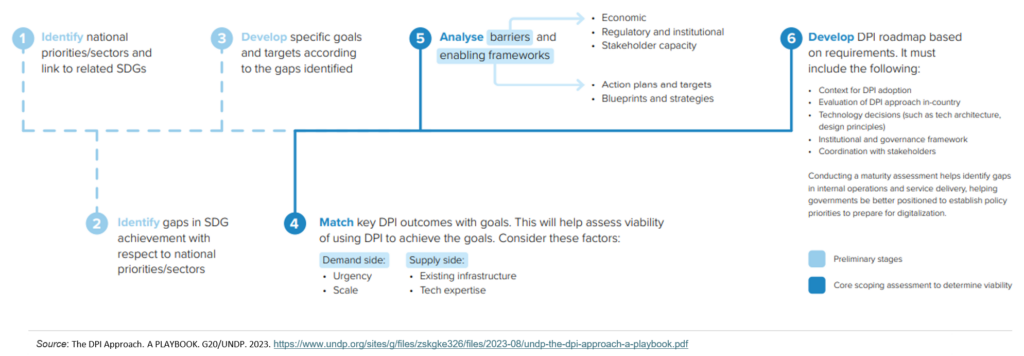
Obviously, each institution, in full alignment with its fundamental objectives and strategies, highlights the relevance of the DPI from its own perspective, while respecting the technological and principled integrity of the ecosystem. In order to facilitate the successful adoption of the DPI, each country should assess how it can implement the DPI while adapting it to its social, economic and political context before launching the first project to adopt the DPI. To this end, the UNPD is proposing a six-phase roadmap, as shown in the image below:
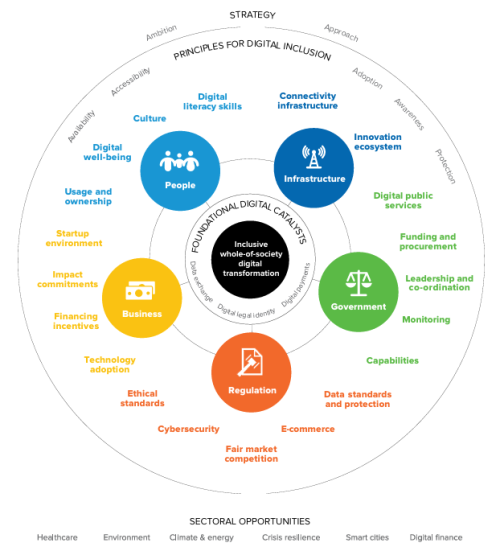
The UNDP is working to define a comprehensive societal approach to digital innovation, based on the conviction that it affects us all (governments, businesses and civil society). As shown in the image below, this approach incorporates the complex involvement of a broad spectrum of actors to promote inclusive design, empowering vulnerable populations to access digital services. It also helps mitigate the risks posed by digital platforms through a rights-based approach and establishes accountability mechanisms. This addresses the risks and harms associated with technology, such as cybersecurity, misinformation and digital privacy issues, all of which pose a threat to democratic governance and social cohesion [10].
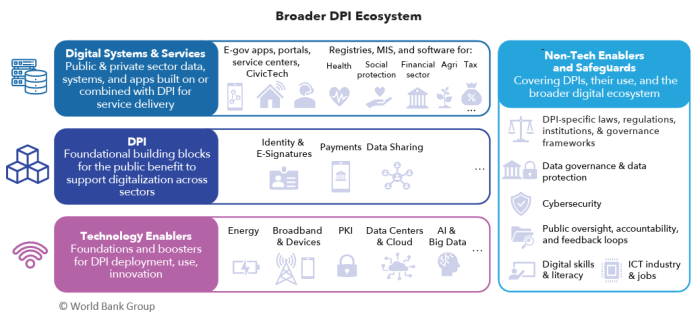
When discussing the role of DPI in developing the digital society, the World Bank states: ‘The DPI approach differs from traditional digitisation efforts in several ways, although there is no single model or plan for its implementation.’ It emphasises the importance of shared, reusable building blocks, fosters collaboration across society (including strong private-sector engagement) and integrates core principles such as openness, interoperability, data protection and user choice. This contrasts with a fragmented approach, in which each sector develops its own isolated digital systems, leading to redundancy, inefficiency and high costs.” The practical implementation of this approach will vary by country or jurisdiction. However, regardless of the model adopted, DPI requires strong and sustained political commitment, meaningful and frequent stakeholder engagement, institutional and technical capacity, and comprehensive legal and regulatory frameworks, among other success factors” [11].
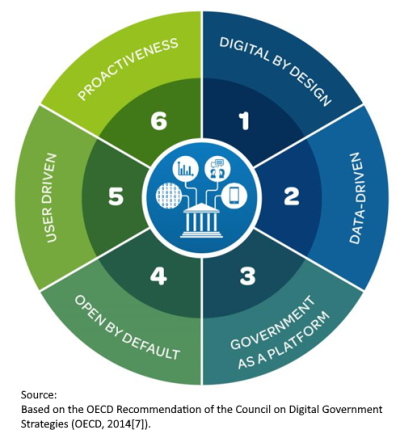
For its part, the OECD has developed its OECD Digital Government Policy Framework, based on the six dimensions that should characterize a digital government [12], summarized in this image:
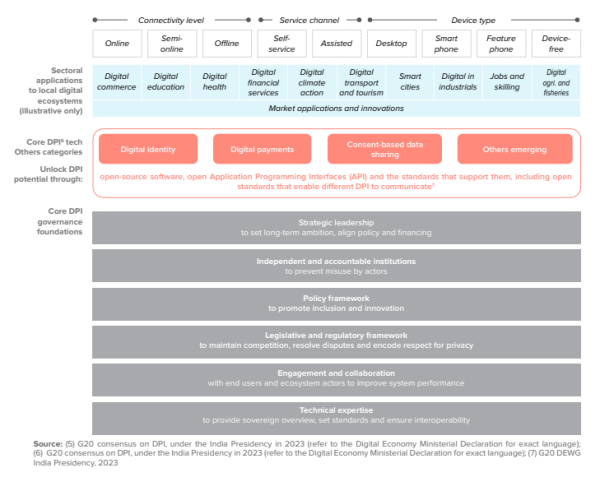
The G20 and the United Nations Development Program published a document aimed at helping countries advance their digital transformation. The document defines a framework for understanding its approach to the DPI (see image below) and the following technological, governance, and community principles of the DPI [13]:
In recent years, the European Union has adopted a broader and more integrated approach to monitoring and analyzing progress in the digital society. As part of this process, beginning in 2023, the Digital Economy and Society Index (DESI) was integrated into the State of the Digital Decade Report, which links competitiveness, sovereignty, sustainability, and democratic values. This approach emphasizes that digital transformation is not only about driving innovation and growth, but also about fostering the most important strategic assets for Europe’s sovereignty, stability, and global influence. This shift in focus has resulted in less detailed information on DPI, to the extent that the 2026 index does not include the concept of DPI [14]. We hope that future reports will provide more explicit information on DPI.
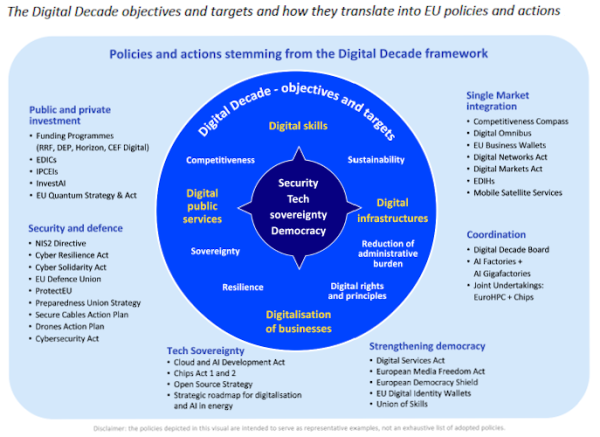
That said, it is absurd that in order to follow the Commission’s work on issues related to digital government and public services, which fall within the framework of EU policies and actions on technological sovereignty, security, defence and democracy, we are told that we must do so via X @EUdigitalID [15]. Not only is this platform not a public EU platform, it isn’t even owned by a European company, but it also contains a lot of content that contradicts the policies and actions outlined in the EU’s Digital Decade Action Plan. When communicating digital government policy, we must be careful and consistent, even with details like this, to avoid contributing to mistrust in digital services.
In addition to the complexities of building digital societies on a national scale, the European Union faces the added challenge of having to provide effective cross-border digital services, which are highlighted as essential to the functioning of its Digital Single Market. n response to this challenge, the European Commission has launched the INVEST initiative, which aims to improve the interoperability of digital public services across the European Union. This initiative is in line with the objectives of the Interoperable Europe Act and the broader goals of the Digital Decade. The INVEST project will define strategic objectives and a detailed action plan, making a significant contribution to the creation of a more connected, efficient and innovative European digital ecosystem [16].
While there are differences in approach, there is an unquestionable consensus that developing and implementing the DPI, like everything done for the benefit of society as a whole, poses an enormous challenge. Implementing the DPI in as many countries as possible and ensuring it is available to all citizens in each of them will require massive collaboration and coordination between the State institutions, governments and private companies. Fortunately, as I hope to have demonstrated, major institutions around the world have been dedicating substantial resources to this end for several years now, even in the world’s poorest countries.
“Mesauring” the current state of DPI worldwige
As mentioned in the previous section, when discussing DPI beyond its fundamental systems (digital identity, digital payments and data exchange), we must consider the different ways in which it is applied in various regions and countries around the world, as well as the most relevant functions in each case. This affects how one might attempt to ‘measure’ the current state of DPI worldwide.
Adding to the complexity of measuring DPI worldwide, as discussed previously, we find that there is a great deal of general information on government digitisation and its structure that does not explicitly refer to DPI. In many cases, not only is the available data varied and sometimes difficult to compare, but there is also a lack of direct, detailed and reliable data on the actual adoption of DPI.
For these reasons, I will present the information that I consider to be the most relevant regarding the state of public digital infrastructures, in accordance with the criteria of the leading sources on this subject. I will strive to present the most credible and direct information on the state of public digital infrastructures, assuming that digital government always requires digital infrastructure to function and deliver digital public services.
Let’s begin with the most global source, the E-Government Development Index (EGDI), which provides a rating of the performance of national governments in the development of digital government across the 193 UN member States. This index is a composite measure of three dimensions of e-government: online service delivery, telecommunications connectivity, and human capital [17].
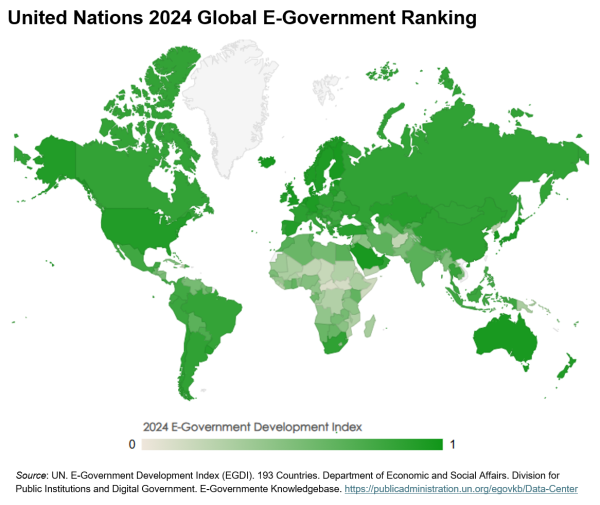
As can be seen on the map provided by the excellent online service E-Government Knowledge Base, the darker shades of green are predominant in many countries [18]. On the website, this map is interactive, so with a few simple clicks, you can access detailed information about each country.
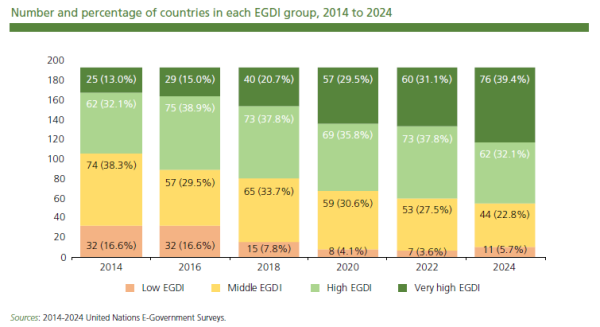
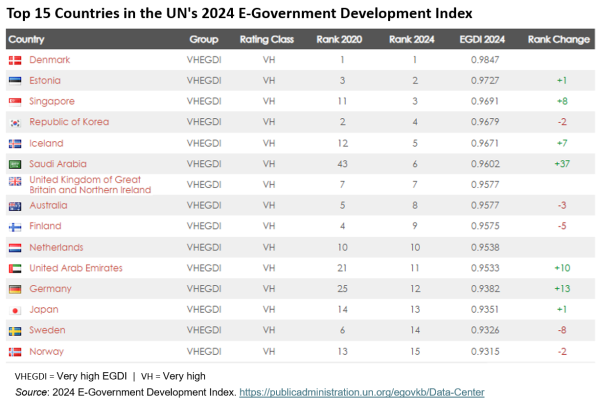
If we supplement the visual information from the map with the data in the following image, this is because in 2024, 71.5% of these countries will have high or very high EGDI scores [19]. Surprisingly, and unlike what is seen with global indicators related to the adoption of new technologies, only 5.7% of the countries included in the survey have a very low EGDI score.
The countries with the best results recorded in 2024 are particularly interesting, not only because of their composition but also because of the significant qualitative leap that some countries have made in four years. The decline in therankings of highly developed European countries over the same period is striking.
With regard to the DPI’s own online services, the United Nations’ Online Service Index (OSI) for 2024 is a composite indicator that assesses how effectively governments use technology to deliver public services at the national level. As can be seen in the image below, there are some differences in the global top 15 compared to the previous EGDI index:
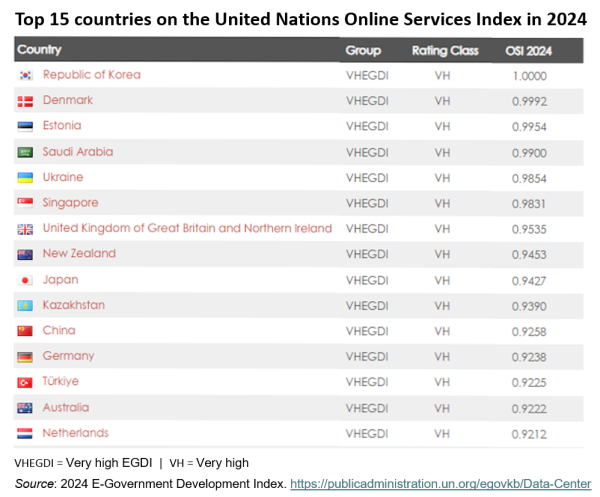
In all cases, regardless of the characteristics of the country and the general information we have about them and their governments, it is striking that the OSI index for all countries is very high.
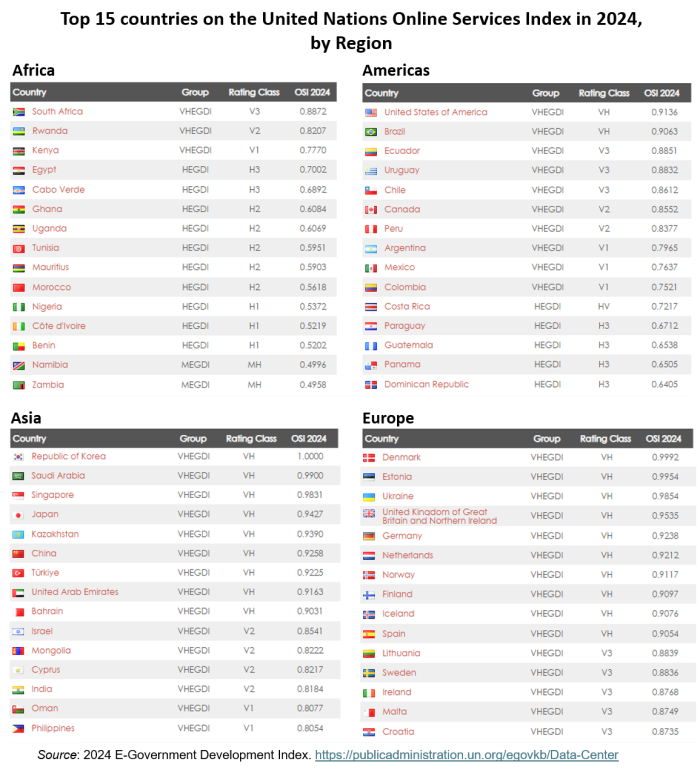
As can be seen in the image below, with the exception of the values recorded in Africa, the OSI index for the top 15 countries in Asia, the Americas, and Europe is not only high (most of them fall into the “Very High EGDI” group), but they also fall within similar ranges.
And finally, the United Nations’ 2024 Local Online Service Index (LOSI), which ranks the e-government portals of selected cities. This index comprises 95 indicators related to six criteria: institutional framework (5), content provision (30), service provision (30), participation and engagement (10), technology (18), and the recently added sub-index on e-government literacy (10). The LOSI 2024 includes 193 cities, of which 151 currently have an online presence.
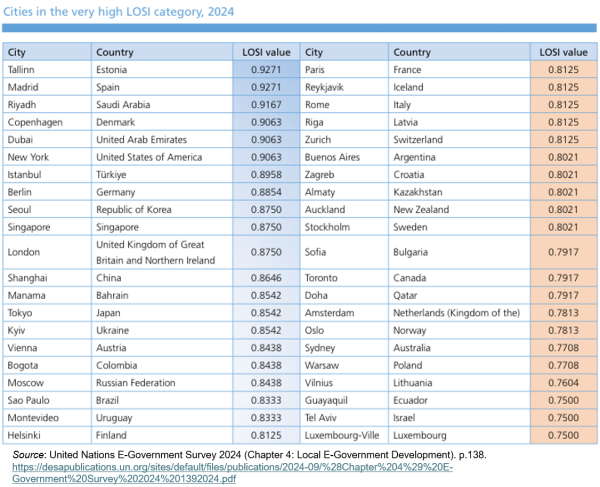
The table highlights that, among the 42 cities in the “very high” and “high” categories, European cities (22) lead the way in adopting advanced infrastructure for their digital services, followed by cities in Asia (11) and the Americas (7), regions that perform well on this index. What is concerning is that none of the most populous cities in African countries achieved the “very high” LOSI rating.
These local online services are important because they allow citizens to access significant amounts of content to help them stay informed about the various sectors of local government and obtain information on how to manage their daily needs. As shown in the image below, municipal portals around the world prioritise providing information that addresses citizens’ most pressing needs, as well as the municipality’s contact information, general information about the municipality, and details on available online services. However, for now, these portals prioritise providing information online (the easiest and least expensive option) over delivering digital public services. This is, of course, perfectly fine for the early stages of digitisation, but given their important role in many citizens’ daily interactions with public administrations, municipalities still have a long way to go in advancing the delivery of digital services characteristic of the Digital Public Information (DPI) framework.
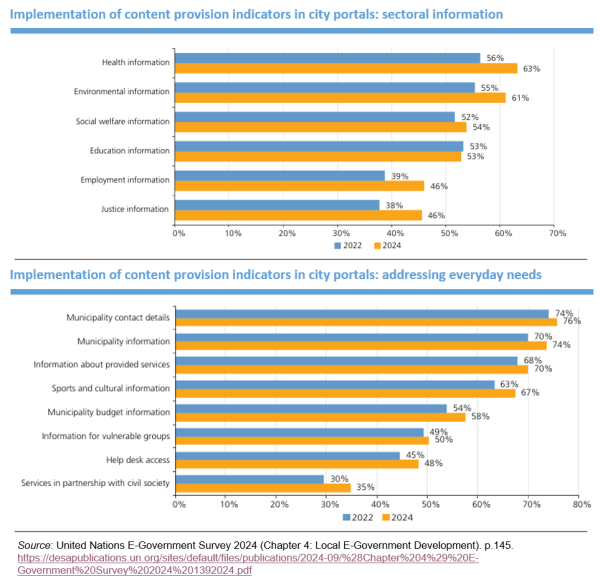
All of this data from the United Nations although, unfortunately, it is not more recent shows a very positive trend in both the growth of digital government and its online services on a global scale, with promising figures for 2024. It also highlights the significant effort that still needs to be made to implement a robust digital public infrastructure in Africa [20].
This trend is also reflected in the OECD’s recent report Digital Government Outlook 2026 , which presents findings illustrating how the governments of 36 member countries and 8 candidate countries of this international organization (virtually all of which coincide with those scoring high and very high on the United Nations index) have been working and investing to improve digital transformation in recent years.
Based on a different methodology, this report examines both the progress made and the persistent gaps in the results of the 2025 OECD Digital Government Index (DGI) and the Open, Useful, and Reusable Data Index (OURdata), and sets out priorities for governments to turn their digital ambitions into tangible impact. Below, I will present the most important summary information from the report for the purposes of this article.
The first notable finding in this report on the state of digital government in OECD member countries in 2025 is the average increase in the DGI, a trend that is also evident in candidate countries, as shown in the following figure:
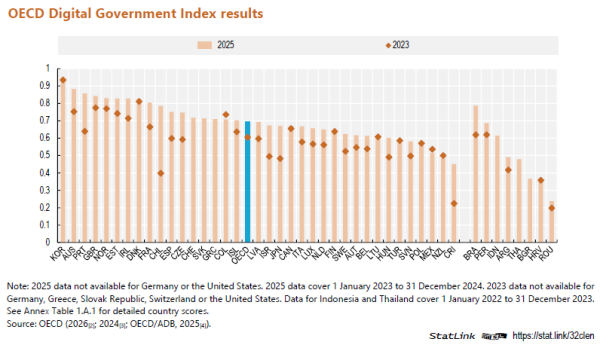
This figure also shows that, despite the progress made in the adoption and growth of digital government during the period under review, the overall pace of progress appears to be slow in most of the countries included in the study.
Another key insight provided by this report for understanding the scope of the DPI is the information summarized in the following figure regarding the areas where activity (and, consequently, investment), has been concentrated:
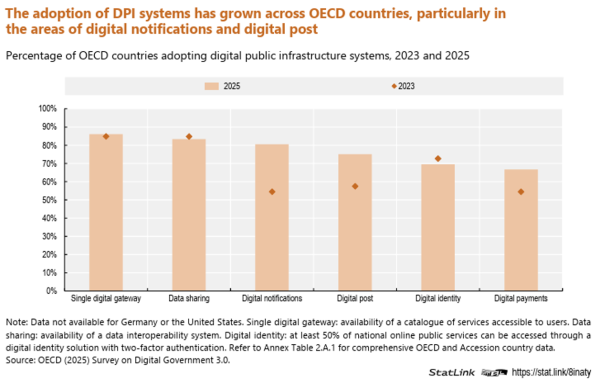
Another noteworthy aspect of this OECD report is the analysis of the key players who are participating in and enabling this process, summarized in the following image:
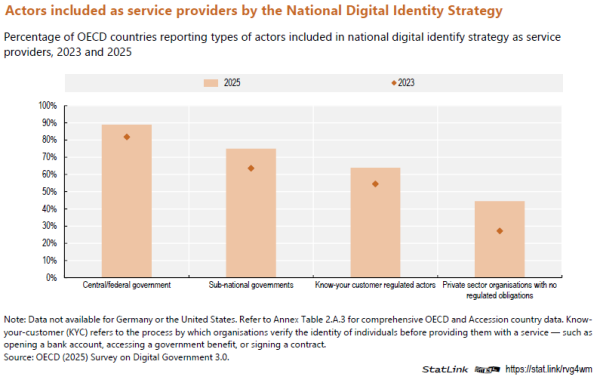
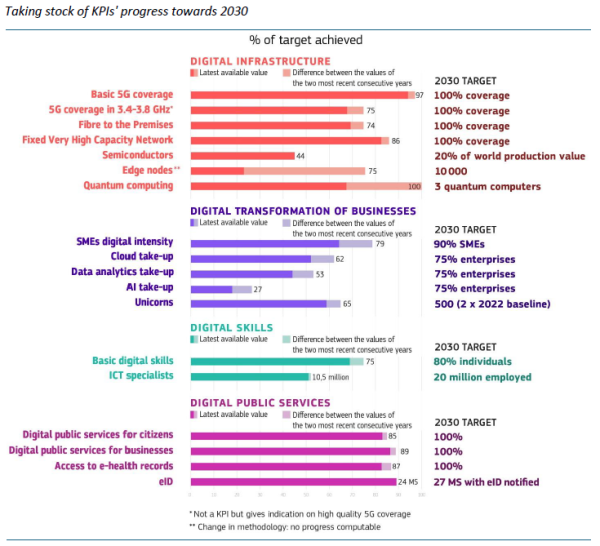
According to the most recent information published by the European Union on the progress of the digital society in recent years, based on the broad approach they are taking (as summarized in the image below), the 2025 metrics show the EU’s digital trajectory, revealing a mixed picture: good results have been achieved in business digitization and the deployment of basic connectivity infrastructure, but this has not been the case in the area of digital public services. In fact, services aimed at both citizens and businesses are projected to reach only about 90% of the target set for 2030 [21]:
Finally, due to the unusually detailed nature of the content, we present data on the worldwide adoption of DPI from a 2025 report by the Institute for Innovation and Public Purpose (IIPP, University College London). Based on a methodology designed for this purpose, the authors created the DPI Map, which provides a comprehensive global overview of the three fundamental DPI systems (digital identity, digital payment and data exchange) in 210 countries. According to this overview [22]:
· at least 64 countries have digital identity systems similar to the DPI
· 97 countries have digital payment systems similar to DPI
· 103 countries have data exchange systems similar to DPI
This report provides details on the implementation of each of the pillar systems of DPI, showing, in each case, data corresponding to the geographic region and the digital systems deployed that align closely with the characteristics of DPI in each country. The summary of this detailed information is as follows:
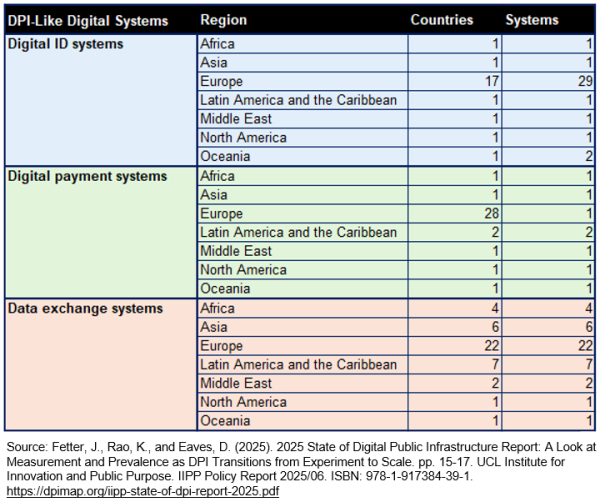
This table reflects the pattern already seen in the EGDI, OSI, and LOSI indices: European countries lead all of these studies on the adoption of public digital infrastructure. In the case of these three indicators, confidence in Europe’s data is supported by: the eIDAS Regulation (eIDAS); the Revised Payment Services Directive (PSD2); the Data Governance Act (DGA); the Data Act; the Open Data Directive (Directive (EU) 2019/1024); the Interoperable Europe Act; the General Data Protection Regulation (GDPR); and others.
Given the data presented above, and considering that this global study on the adoption of the three fundamental systems of the DPI (digital identity, digital payments, and data exchange) included 210 countries, we can conclude that many countries are still far from implementing these systems in a manner that is highly aligned with the characteristics of the DPI.
As we have seen, current digital DPI systems and platforms already make it possible, within the limits of what traditional information technologies can support and in accordance with their implementation priorities, to provide citizens with increasingly secure, efficient and inclusive public services on a global scale. However, these systems have not yet been implemented on a global scale. Furthermore, the pace of adoption of these systems varies greatly depending on a country’s wealth and level of development, whether or not it is a democracy, and the type of e-government service in question (essential or non-essential):
· Essential e-government services
o Digital identity
o Digital payments
o Secure data exchange
o Digital signatures and documents
· Other digital public services:
o Ministries’ websites
o Social security
o Taxation
o Digital health
o Digital education
o Data and digital governance
o Legal services
o Transportation
o …
For security reasons, the core DPI services (digital identity, data exchange and digital payments) are among the most widely used globally. All other digital public services utilise these core services. If this is not the case, the digital services provided to the public are not considered part of DPI. There are currently many such services worldwide.
Technological risks & limitations of DPI
The DPI Safeguards Initiative, launched in September 2023 by the Office of the United Nations Secretary-General’s Envoy on Technology (OSET) and the United Nations Development Program (UNDP), has developed the Universal Framework for Safeguards for Public Digital Infrastructure (DPI) [23], which was updated in 2026.
This framework is based on the understanding that DPI encompasses technological systems and services operating at the intersection between individuals and civic, public and private entities that hold social, political and economic power. It clearly defines that the risks associated with DPI do not arise solely from the technical components of the ecosystem, but also from shortcomings in normative frameworks (ethical, legal and regulatory) and from institutional and organisational inefficiencies. The risks associated with DPI vary considerably across different systems (e.g. payment, identity and data exchange systems) and national contexts. They are neither distributed uniformly throughout society nor necessarily static.
In order to address the complex task of safeguarding DPI, this United Nations framework lists 13 identified risks across the DPI lifecycle, grouped into three categories, that must be addressed and mitigated. These risks are not included in the image, but consist of the following dimensions of DPI safeguards:
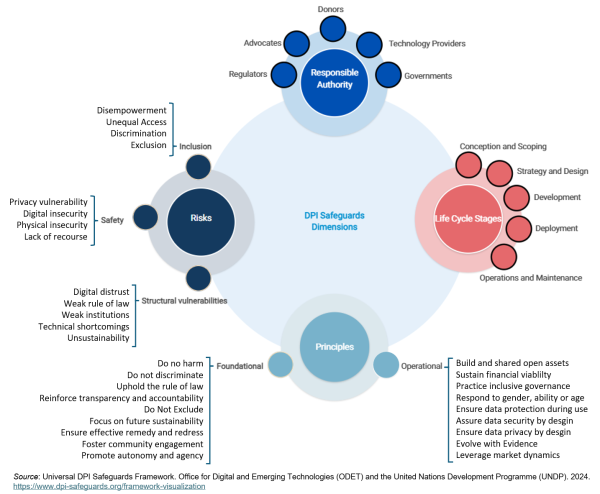
In light of the growing adoption of DPI and the increasing risks of all kinds associated with it, the United Nations has published version 2.0 of the DPI Safeguard Framework [24], with the aim of ensuring that the 18 principles for mitigating risks, both at the individual and societal levels, across all aspects of digital transformation (technical, regulatory, and organizational) contribute to the successful implementation of DPI; guarantee maximum compliance with standards and regulations; and promote the Organization’s Sustainable Development Goals while fostering trust and equity in all countries.
To help improve DPI safeguards in the current era of so-called artificial intelligence (AI), the Centre for Digital Public Infrastructure has created the DPI-AI framework, which incorporates AI as a set of external, interoperable capabilities that connect to the DPI through shared standards, governance mechanisms, and safeguards to mitigate the interrelated risks identified throughout the DPI’s lifecycle. These connections focus on the fundamental pillars of DPI, such as digital identity, data exchange, and payments. This allows external AI systems to authenticate users and institutions, access authorized data, and operate beyond organizational boundaries, without being tightly coupled to specific applications or providers [25].
In today’s complex security landscape, marked by continuous attacks and all-too-frequent vulnerabilities, the automation of high-risk task control offered by this framework can serve as a useful guide on how to continue advancing in mitigating DPI risks without abandoning the approach.
Both frameworks address DPI risks with such breadth and depth that they cover almost everything that is truly relevant in this field. There is little left to add without being repetitive. However, I would like to highlight a few points regarding some relevant risks to ensure the continuity of DPI services:
· An increased reliance on open-source software that does not guarantee its evolution and maintenance in line with the long life cycle of DPI software systems
· The lack of standards for the development, deployment, and maintenance of DPI systems
· The disruption of physical IT and telecommunications infrastructure as a result of a lack of technological sovereignty
· The limitations of hardware and software systems in simultaneously processing the enormous volumes of user requests, variables, data, transactions, etc., that certain public services will require in a digitalized
society
· The risk to the principle of sustainable development posed by high dependence on and consumption of AI services, given the current unsustainable model of AI data centres and their very high levels of water and electricity usage
· The European Union has also identified, and is already working to mitigate, two high risks to the smooth pace of society’s digitization:
o a potential shortage of qualified technicians due to the fact that progress toward the target for ICT specialists has stalled, with significant structural gaps persisting—particularly in terms of human capital, advanced technologies, and the scalability essential for a digital society and its corresponding digital public services [26]
o the growing need for digital authentication that is truly secure, truly unique, “universal,” and supported by institutions, so that citizens can interact with the digital public services of the State and government institutions in a manner similar to how we do so in person when presenting an ID card and/or passport during administrative procedures and at borders [27]
· Failing to incorporate emerging technologies into the DPI ecosystem from a values- and human rights-based approach:
o AI, both due to its ill-conceived and poorly controlled use as part of the DPI (hence the relevance of the DPI-AI proposal) and due to external attacks designed using this technology to detect vulnerabilities. The core services of the DPI are highly attractive to hackers, so it won’t be long before AI models specialized in the DPI emerge.
o Although curiously not mentioned in the documents from the major institutions cited in this article, there is also the now widely recognized technological risk that quantum technologies will pose to the DPI’s classical security systems; we must begin working on mitigating this risk immediately.
To a large extent, many of these risks are also related to some of the major technological limitations that DPI currently faces and must contend with:
· Many of the systems and applications still in use for public digital services are supported by “legacy” software, which hinders the efficient integration of the modern developments required for public digital services
· The integration of many of these systems and applications with the DPI is carried out using custom solutions for “legacy” software, rather than as part of a single, robust, modular architecture that, by design, provides security, extensibility, scalability, high performance, and availability
· The security vulnerabilities often resulting from the situations described in the two previous points are very easily detectable by current AI models.
· Interoperability issues that still exist among different State and government institutions due to the persistence of “digital silos” within them
· Excessive reliance on external commercial technology providers for the DPI
· The inability of legacy systems to provide certain digital public services to the public that require personalized processing and responses with individualized precision in real time
The digitisation of the State and government institutions so that they can perform all their public functions and services digitally (with all the necessary safeguards) is a new, enormous task for humanity. No one should underestimate or downplay this challenge, as it is enormous and fraught with complexities, unforeseen discoveries, risks and implementation, operational and security problems over a prolonged lifecycle. All of these issues will need to be identified and overcome.
The Impact of the DPI on Digital Democracy
To speak of digital democracy is to address a topic where indifference is not an option. It involves delving into a highly contentious arena, where enthusiasts, supporters, conservatives, detractors, deniers and representatives of every conceivable position on the matter rarely find room for compromise.
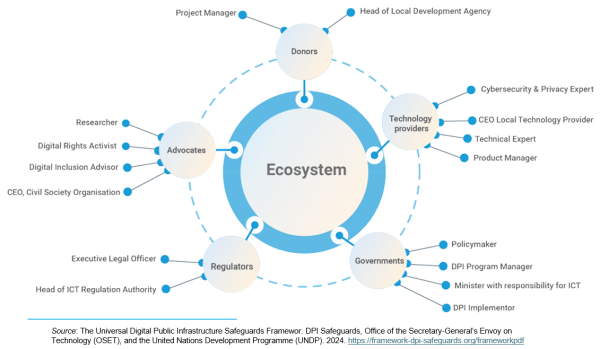
Designing and implementing an ecosystem to effectively support the digital replica of the State and all its institutions, organisations and key players is far more complex than simply deploying a few websites and online public services. This is the enormous challenge facing the United Nations’ DPI initiative: creating, as shown in the image below, a complex technical, regulatory and organisational ecosystem that provides maximum safeguards for digital transformation, while ensuring full compliance with the standards and regulations governing digital public infrastructure and democratic principles.
The scale of this process is so vast that it involves creating an ecosystem for digital existence. Since this goes far beyond technological systems for processing information, I still find the term ‘virtual’ [28] much more accurate. This applies to all levels and key players in public life, not just digital avatars and caricatures:
· The State and its digital institutions
· Digital government
· Digital president
· Digital political party
· Digital voter
· Digital public administration and organizations
· Digital public services
· Digital public officials
· Digital democracy
· Digital culture
· Digital citizen
· and a very long list of others
Digital democracy, as I envision, understand, and present it, largely aligns with the definition offered by Fischli and Muldoon [29], as a sociotechnical system that incorporates the use of digital technologies to enable or enhance democratic practices and forms of governance. It incorporates a diverse array of practices, from open-government initiatives that foster greater transparency and legitimacy to citizens providing ideas to governments and even making binding decisions on policies and legislation.
If the rapid digitalization we are currently experiencing has contributed anything, it is that it has dispelled a significant portion of the reasonable doubts that existed regarding the importance of digital democracy for the essential modernization of democratic institutions.
In this regard, the OECD’s commitment and perseverance stand out; for several years, it has been devoting special attention to the need to strengthen democracy by leveraging the opportunities offered by digitalization. In this regard, it is worth referring to the latest edition of the OECD Initiative for Strengthening Democracy [30], in which the organization advocates for transforming public governance for digital democracy, and especially ANNEX E. Action Plan on Transforming Public Governance for Digital Democracy, which identifies three key areas of work and the steps needed to address them:
· Strengthening Democratic Representation and Participation in the Context of Digitalization
· Modernizing Democratic Institutions to Address the Opportunities and Challenges of Digitalization for Democracies
· Leveraging Key Policy Tools to Address the Opportunities and Challenges of Digitalization for Democracy
Beyond its content and specific objectives, this OECD approach takes a pragmatic and well-reasoned look at what is an open secret: the urgent need to strengthen democracy by leveraging the opportunities offered by the digital transformation of society and the economy, without pitting the form (digital) against the essence of the entity (democracy).
No matter how modern the term ‘digital’ may sound, digital democracy should not be viewed as an alternative to the democracy we know, nor as an antagonistic counterpart, but rather as a new form that democracy is taking as a result of an unprecedented qualitative leap in its evolution, driven by the digitisation of the State and its institutions.
Until now, most resources invested in developing the DPI have focused on developing its fundamental systems (digital identity, digital payments and data exchange) and creating digital platforms to provide certain digital public services that governments have identified as priorities, notably those that contribute to economic development, inclusion and recognition of the fact that this ecosystem operates under democratic principles by design. Consequently, the cumulative impact of the DPI on democracy as a channel for digital democratic participation remains limited.
Given the characteristics of the DPI ecosystem model and the breadth and variety of elements that make up democracy, enabling digital democracy to become part of the DPI will be far more complex than enabling digital identity, digital payments and data exchange. And this is no exaggeration.
As part of a harmonious whole in the context of digital democracy, we must consider and integrate many technological and human elements into the DPI, which presents an enormous technical, technological and functional challenge. However, based on my years of experience designing, developing and managing advanced, custom-built projects involving classical, quantum and hybrid software, I am optimistic that it is feasible, in fact, I am convinced of it.
To achieve this, we will need to be very creative when designing, developing, integrating and maintaining the various modules required by the systems that will make digital democracy an integral part of the DPI. Each module must be able to support a large number of variables and manage a significant amount of data, while ensuring acceptable response times for public services and interoperability with the rest of the DPI systems.
In this regard, Silvana Rodríguez’s reflection on the value that a “Democracy Stack” could bring to solving this major challenge is thought-provoking, as she envisions it incorporating conceptual components and additional functions based on democratic indicators [31]. A Stack inspired by Waag Futurelab’s definition of a “public stack” [32], created with an approach in which all layers contributing to the technology, the core values, the design process, the technology itself, and the way these layers position people, are grounded in democratic values.
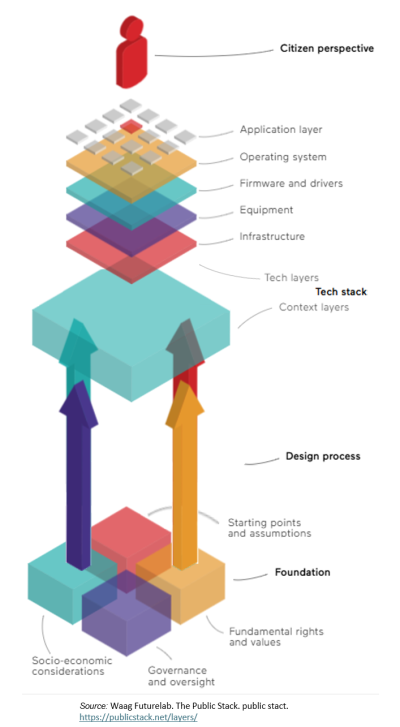
This diagram shows an expanded version of the Waag Futurelab stack. It presents all the elements of its high-level technological architecture in a single visual representation, showing everything displayed on the website when interacting with each of its layers. The aim is to create open, democratic and sustainable digital public spaces.
As this architecture and its objectives share many similarities with the DPI initiative, it could serve as a starting point for designing the high-level architecture of potential digital democracy software for the DPI.
To begin this training, I suggest the following guidelines. At a minimum, the base layer should include the current broad legal framework that underpins democracy in each country, as well as the DPI’s technological, governance and community principles. In the context layers, the fundamental components for integration and interoperability with the DPI must be added by design: digital identity verification, secure data exchange and digital signatures.
As we demonstrated in the previous instalment, alongside corruption, the rule of law and civil liberties, participatory democracy is one of the four fundamental indicators used to assess the quality of democracy. In the realm of digital democracy, this indicator remains fully relevant and valid for analysing and assessing the health of democracy, measuring its progress and gaining a detailed understanding of how citizens exercise their right to participate.
One of the sources that provides global information on citizen participation in digital democracy is the United Nations’ E-Participation Index (EPI), which is derived as a complementary index to the EGDI and consists of three main components: e-information, e-consultation, and e-decision-making. The visual representation of the status of this indicator worldwide in 2024 is as follows:
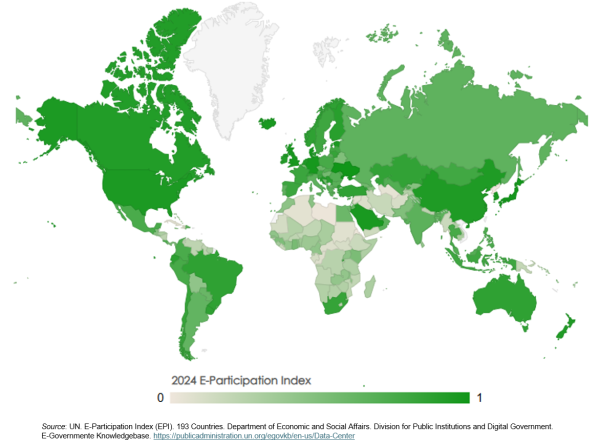
If we compare the 2024 EPI data with the democracy indicators and the EGDI for that same year, we can see in the table below that only 53% of the countries with the highest democracy scores in the world ranked highly on the EGCI, and only 40% on the EPI. This is undoubtedly a poor result, demonstrating that these countries are not being proactive in taking advantage of the opportunities offered by their high level of digitization to strengthen one of the key indicators of the quality of democracy and address one of the major limitations of an excessively representative democracy: citizen participation.
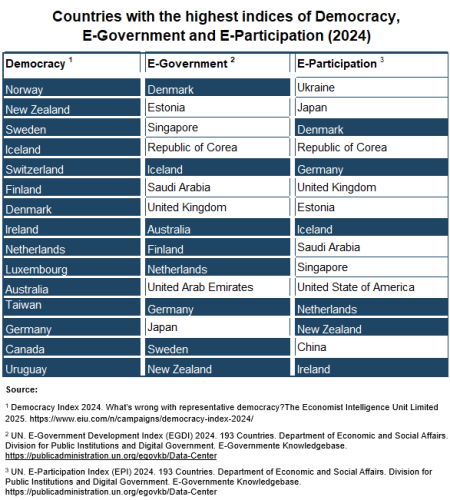
As is evident in the extensive literature published on advances in PDI, to date most governments and institutions have focused primarily on systems that yield the greatest immediate benefits for the delivery of public services, economic development, and inclusion through online portals. To some extent, this is understandable because, unlike the digitization of other public administration activities (especially for reasons of security, privacy, and trust), the digitization of democracy requires a very high level of maturity in the technologies used for this purpose in e-democracy.
One of the major challenges facing the digitization of government is the need for it to improve its credibility, which will have a direct impact on the public’s confidence in its transition toward a digital government. In fact, according to an OECD survey, in 2025, 43% of the population in OECD countries had little or no trust in their national government, compared to 40% who had high or moderately high trust [33].
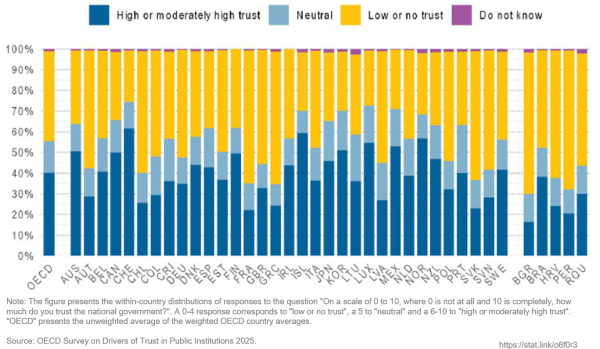
As can be seen at a glance from this table, although there are significant variations among countries and population groups, it is clear that even among the countries classified as full democracies that we listed in the previous article [34], levels of distrust in the government are high; and this, which is undoubtedly not a good indicator of traditional representative democracy, could be a major obstacle to progress toward a fully digital government.
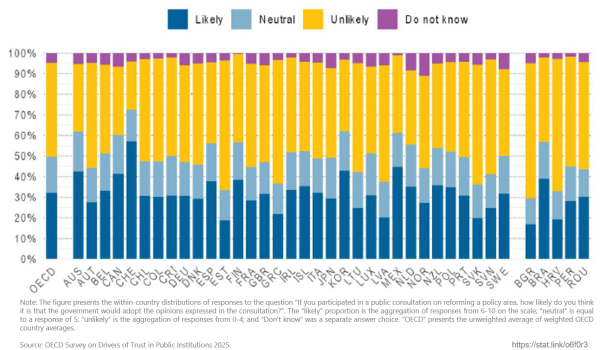
As shown in the image above, the same survey also found that, although voting is the most common way for people in these countries to participate in political and civic life, on average 60% of the population perceives that voting in regional or national referendums has a moderate or insignificant influence, and only 32% consider it likely that the government will adopt the opinions expressed in public consultations [35].
Moving towards broader citizen participation, in which citizens feel heard beyond election day, are able to limit their representatives’ excesses, and new pathways towards participatory digital democracy emerge, is not just an option, but a vital necessity for democracy.
Digital democracy requires every eligible voter to be able to participate fully, without barriers. To make this possible, DPIs must incorporate solutions into their systems so that all citizens can fully exercise their rights. Governments must also define an appropriate digital literacy policy to mitigate technological exclusion and bridge the digital divide, at both the national and societal levels. In the latter case, there should be a particular focus on generational exclusion.
Currently, the most widespread digital democracy services within public digital infrastructure are typically limited to:
· Platforms providing information to citizens
· Transparency portals (primarily in Europe)
· Online debate and discussion of topics selected by the government
· Tools for citizen participation in issues of lesser importance to democracy and that are usually non-binding
· Certain types of electronic voting in local, regional, national, or international elections, primarily limited to elected officials
· Some votes in online citizen consultations—mostly non-binding—on specific issues at the local, regional, national, or international level
An example of the types of services listed above is the information in the following United Nations chart on the implementation of participation and interaction indicators on municipal portals in 2024:
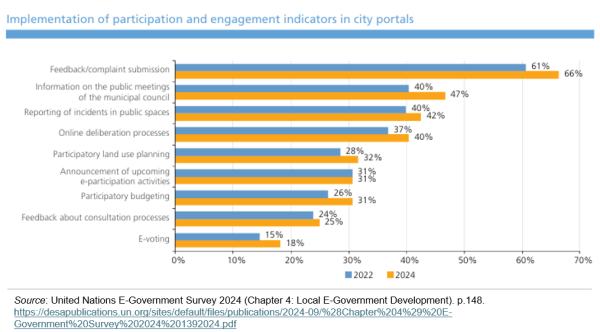
Of course, having access to information from these digital services on digital democracy is great, but it would be a mistake to limit the contribution that the DPI can make to digital democracy to these services alone.
The insights shared by Fischli and Muldoon regarding experiments in decentralised participatory democracy at the municipal level [36], based on an analysis of two European pilot projects, are also enlightening: D-CENT (Decentralised Technologies for Citizen Participation) and DECODE (Decentralised Data Ecosystems Owned by Citizens), are also enlightening. Their article provides further information and analysis on these pilot projects for those interested:
· Digital Democracy and Data Commons, a pilot project at the Barcelona City Council
· Citizen Science Data Governance, a pilot project in Barcelona
· Gebiedonline (Neighborhood Online): a pilot project in Amsterdam
· Amsterdam Digital Registry, a pilot project in Amsterdam
To better understand the impact of DPI on digital democracy, and in particular citizen participation in it, we must consider criteria that allow us to understand how this is currently taking place. It is essential that we can measure the current state of digital democracy as precisely as possible at any given moment, so that we can project its future trajectory more accurately.
As there are many methods, models and criteria for measuring levels of democratic participation, it is important to choose the one that is best suited to the global-scale perspective that you wish to present. When deciding how to present the level of digital participation, I found the book Design Thinking as a Strategic Approach to E-Participation extremely helpful [37]. Building on a theoretical framework for digital participation, the authors address the complexity of this issue, summarise it, and clearly propose a reasonably well-argued method for measuring the scope and nature of citizen engagement in democracy through maturity levels.
The perspective they provide is highly illuminating in this regard, particularly through their adaptation of Tina Nabatchi’s ‘Public Participation Spectrum’ framework [38], which effectively simplifies and clarifies the objective of public participation and the government’s commitment to its citizens.
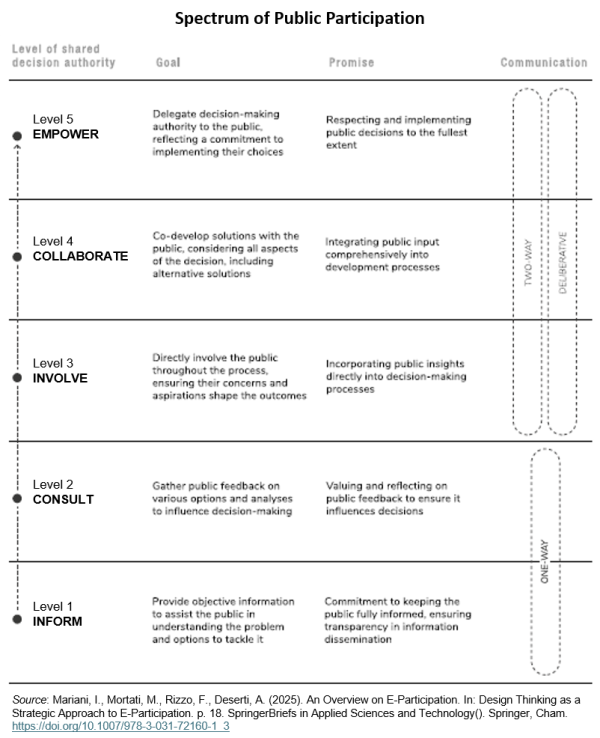
As can be seen in the above image, this framework illustrates a progression ranging from passive participation, characterised by one-way communication at levels 1 and 2 in most cases, to the gradual empowerment of citizens at higher levels. By combining levels of citizen participation with the government’s commitment to its citizens and the dimension of communication, the framework clearly illustrates the complex, varied and innovative landscape of digital participation today.
Applying this conceptual framework to the state of the indices presented in this article reveals that digital participation today is largely at levels 1 and 2 on a global scale: informative and consultative, with a one-way flow of information and limited influence of participants in decision-making. While these levels represent a good starting point given the nascent nature of digital democracy, they also demonstrate the significant progress required to align with the maturity of democracy and the advancement of society’s digital transformation.
This situation should come as no surprise, as citizen participation in democracy today is more contemplative/informative than participatory, indicating its low level of maturity. This is a real cause of the current level of digital participation, beyond technological limitations. In fact, digital services have helped to improve certain aspects of democracy in recent years.
In order to increase participation levels, the DPI’s systems and platforms for democracy must guarantee the active democratic participation of all those entitled to it. The DPI ecosystem must include IT systems that are based on public policies and aligned with legal norms and procedures, in order to safeguard and strengthen digital democracy. To this end, the ecosystem must have tools and solutions that guarantee this by design:
· engagement through various digital channels, not just websites
· the dissemination of the truth; Serving as an unquestionable source of verified content; Fostering an ecosystem free from lies, manipulation and deception for political purposes, or originating from political spaces and positions, scourges plaguing many digital environments todaythe elimination of hate speech (e.g., racism, xenophobia, anti-semitism, homophobia, etc.)
· having effective mechanisms in place to participate in the management of social wealth, to which the population contributes through taxes, and to prevent the misappropriation and mismanagement of this wealth
As with any comparable system, digital democracy presents risks. However, the opportunities it offers to modernise democracy are far more significant, whether its activities take place in person or digitally.
Despite its current technological limitations, the DPI ecosystem is the most effective way to advance the development of digital democracy. Given these limitations, quantum technologies could play a significant role in enhancing the DPI’s capabilities and enabling the optimisations necessary for regenerating democracy on a global scale.
Summary
Digital Public Infrastructure (DPI), which is based on traditional information technologies, is ushering in the latest chapter in the evolution of the digital State. This marks the beginning of a new era in public services.
As the digitisation of public services accelerates, DPI is becoming a strategic resource for the future success of every country. It is vital for defining the characteristics that will be most relevant to societies in the future, such as modernity, democracy, competitiveness and security.
The information presented in this article clearly shows that significant progress has been made in DPI on a global scale in recent years. However, it is equally evident that the pace of its implementation is uneven globally, with Africa and some Asian countries still having much to do.
Europe and its countries lead the way in all studies on the adoption of public digital infrastructure, demonstrating a high level of alignment with DPI systems. Their high quality and reliability standards are supported by advanced legislation and standards governing the digitisation process, which can serve as benchmarks for other countries.
The success of this colossal social and technological project will largely depend on the DPI’s ability to evolve by integrating and supporting all necessary safeguards as a native and indivisible part of this ecosystem centred on the user and the privacy of individual information:
· The development and evolution of scalable, robust, and secure core DPI systems for digital identity, digital payments, secure data exchange, and digital signatures and documents
· The development and evolution of systems and platforms for digital public services that are secure and interoperable with the core DPI systems
· The most advanced enabling technologies available at any given time to ensure their growth, maturity, and security
· Compliance by design with non-technological enabling safeguards, which are essential for a fulfilling digital life characterized by equality and rights, in line with an advanced democratic digital society
· Security and its constant updating, resilient against known and emerging threats
The full digitisation of the State, its institutions, the government, public administrations, organisations and citizens is not just a technological task. To do so would be the easy way out and a colossal mistake. The real challenge is much more complex and multifaceted: to create the tools and technological ecosystem for a Digital Public Infrastructure (DPI) that will enable the seamless digitisation of social, political, economic and cultural relations between citizens, governments, businesses, political parties and countries, among others, within a mature digital environment befitting a democratic State.
Since its inception, the DPI has been endorsed by both the UN and the G20, and it enjoys widespread support from all major international organisations and institutions. Managed by governments at national and local levels, the DPI is presented as the most appropriate framework for ensuring compliance with laws, regulations and procedures, and for strengthening democracy by promoting digitisation and the necessary oversight bodies. Digital democracy, with its complex technological, social and legal architecture, must become another IT system within the DPI. To this end, it is essential to make highly effective, resilient, secure and reliable public digital infrastructure available for the common good.
While a digital public infrastructure may be technically sound, if it is poorly designed, insufficiently regulated, and fails to prioritise the user and democratic values of a digital society, it could pose a risk to the society in which it is implemented by being used for anti-democratic purposes. This would fall outside the definition of DPI outlined in this article.
The technological limitations of DPI pose critical barriers to governments’ ability to implement shared systems efficiently, such as digital identity, payment platforms and secure data exchange, given the enormous variety and volume of digital services that must be provided to citizens. In the final part of this series, I will discuss some technologies that could enable DPI to make a technological leap forward, improving service quality and definitively eliminating the technical bottlenecks caused by the most significant limitations of classical computing in this type of project. These limitations prevent DPI from being radically more effective, resilient and secure.
[1] OECD (2020), “The OECD Digital Government Policy Framework: Six dimensions of a Digital Government”, OECD Public Governance Policy Papers, No. 2, OECD Publishing, Paris, https://doi.org/10.1787/f64fed2a-en.
[2] Peterssen, G. Democracy & Quantum Technologies (I). The current state of democracy. The QPath Blog. https://www.quantumpath.es/2026/09/01/democracy-quantum-technologies-i-the-current-state-of-democracy/
[3] UNDP. Digital Public Infrastructure (DPI). https://www.undp.org/digital/digital-public-infrastructure
[4] Clark, J., Marin, G., Ardic Alper, O.P., Galicia Rabadan, G.A. 2025. Digital Public Infrastructure and Development: A World Bank Group Approach. Digital Transformation White Paper, Volume 1. © Washington, DC: World Bank. https://documents1.worldbank.org/curated/en/099031025172027713/pdf/P505739-84c5073b-9d40-4b83-a211-98b2263e87dd.pdf
[5] OECD. Government at a Glance 2025. https://www.oecd.org/content/dam/oecd/en/publications/reports/2025/06/government-at-a-glance-2025_70e14c6c/0efd0bcd-en.pdf
[6] International IDEA. Digitalization and Democracy. Digital Public Infrastructure. https://www.idea.int/theme/digital-public-infrastructure
[7] CDPI Abadie, D. (2026). DPI-AI Framework: Building AI-Ready Nations through Digital Public Infrastructure. https://digitalpublicinfrastructure.ai
[8] Fetter, J., Rao, K., and Eaves, D. (2025). 2025 State of Digital Public Infrastructure Report: A Look at Measurement and Prevalence as DPI Transitions from Experiment to Scale. UCL Institute for Innovation and Public Purpose. IIPP Policy Report 2025/06. ISBN: 978-1-917384-39-1. https://dpimap.org/iipp-state-of-dpi-report-2025.pdf
[9] ACCELERATING THE SDGS THROUGH Digital Public Infrastructure. A COMPENDIUM OF THE POTENTIAL OF DIGITAL PUBLIC INFRASTRUCTURE. G20/UNDP. 2023. https://www.undp.org/publications/accelerating-sdgs-through-digital-public-infrastructure-compendium-potential-digital-public-infrastructure
[10] United Nations Development Programme. Digital Strategy 2022-2025. pp. 21-22 https://digitalstrategy.undp.org/
[11] Clark, J., Marin, G., Ardic Alper, O.P., Galicia Rabadan, G.A. 2025. Digital Public Infrastructure and Development: A World Bank Group Approach. Digital Transformation White Paper, Volume 1. EXECUTIVE SUMMARY. © Washington, DC: World Bank. https://documents1.worldbank.org/curated/en/099031025172027713/pdf/P505739-84c5073b-9d40-4b83-a211-98b2263e87dd.pdf
[12] OECD (2020-10-07), “The OECD Digital Government Policy Framework: Six dimensions of a Digital Government”, OECD Public Governance Policy Papers, No. 02, OECD Publishing, Paris. http://dx.doi.org/10.1787/f64fed2a-en
[13] ACCELERATING THE SDGS THROUGH Digital Public Infrastructure. A COMPENDIUM OF THE POTENTIAL OF DIGITAL PUBLIC INFRASTRUCTURE. G20/UNDP. 2023. https://www.undp.org/publications/accelerating-sdgs-through-digital-public-infrastructure-compendium-potential-digital-public-infrastructure
[14] State of the Digital Decade 2026: Closing structural gaps and mobilising investments for 2030 and beyond. EUROPEAN COMMISSION. 2026. https://digital-strategy.ec.europa.eu/en/library/state-digital-decade-2026-closing-structural-gaps-and-mobilising-investments-2030-and-beyond
[15] Digital public services and environments. European Commission. https://digital-strategy.ec.europa.eu/en/policies/digital-public-services
[16] INVEST – Interoperability Vision in Europe-Strategy Timeplan. https://interoperable-europe.ec.europa.eu/
[17] UN. E-Government Development Index (EGDI). 193 Countries. Department of Economic and Social Affairs. Division for Public Institutions and Digital Government. E-Governmente Knowledgebase. https://publicadministration.un.org/egovkb/en-us/About/Overview/-e-Government-Development-Index
[18] UN. E-Government Development Index (EGDI). 193 Countries. Department of Economic and Social Affairs. Division for Public Institutions and Digital Government. E-Governmente Knowledgebase. https://publicadministration.un.org/egovkb/Data-Center
[19] UN. E-Government Survey 2024. Accelerating Digital Transformation for Sustainable Development. With the addendum on Artificial Intelligen. p. 37. UNITED NATIONS, New York, 2024. https://publicadministration.un.org/egovkb/en-us/
[20] OECD (2026), Digital Government Outlook 2026: From Foundations to Transformational Impact, OECD Publishing, Paris, https://doi.org/10.1787/0496b2bc-en
[21] State of the Digital Decade 2026: Closing structural gaps and mobilising investments for 2030 and beyond. pp. 4-5. EUROPEAN COMMISSION. 2026. https://digital-strategy.ec.europa.eu/en/library/state-digital-decade-2026-closing-structural-gaps-and-mobilising-investments-2030-and-beyond
[22] Fetter, J., Rao, K., and Eaves, D. (2025). 2025 State of Digital Public Infrastructure Report: A Look at Measurement and Prevalence as DPI Transitions from Experiment to Scale. UCL Institute for Innovation and Public Purpose. IIPP Policy Report 2025/06. ISBN: 978-1-917384-39-1. https://dpimap.org/iipp-state-of-dpi-report-2025.pdf
[23] The Universal Digital Public Infrastructure Safeguards Framework. A Guide to Building Safe and Inclusive DPI for Societies. DPI Safeguards initiative | Office of the UN Secretary- General’s Envoy on Technology (OSET) | United Nations Development Programme (UNDP). September 2024. https://framework-dpi-safeguards.org/frameworkpdf
[24] The Universal DPI Safeguards Framework is live. United Nations Office for Digital and Emerging Technologies (ODET) and the United Nations Development Programme (UNDP). 2026. https://www.dpi-safeguards.org/
[25] CDPI Abadie, D. & Muriithi, A. (2026). DPI-AI Framework: Building AI-Ready Nations through Digital Public Infrastructure. https://digitalpublicinfrastructure.ai
[26] CDPI Abadie, D. & Muriithi, A. (2026). DPI-AI Framework: Building AI-Ready Nations through Digital Public Infrastructure. https://digitalpublicinfrastructure.ai
[27] State of the Digital Decade 2026: Closing structural gaps and mobilising investments for 2030 and beyond. pp. 4-5. EUROPEAN COMMISSION. 2026. https://digital-strategy.ec.europa.eu/en/library/state-digital-decade-2026-closing-structural-gaps-and-mobilising-investments-2030-and-beyond
[28] ‘The virtual is not opposed to the real, but to the actual. The virtual constitutes an entity, comprising the inherent virtualities of a being, its problems, and the web of tensions, pressures and projects that animate them.’ Lévy. P. ¿Qué es lo virtual? Pag. 11. Editorial Paidós. 1999. https://books.google.es/books?id=ocgWAAAACAAJ&hl=es&lr=&num=20
[29] Fischli R, Muldoon J. Empowering Digital Democracy. Perspectives on Politics. Digital Technology, Power, and Democracy pp. 821. 2024;22(3):819-835. doi:10.1017/S1537592724000409 https://www.cambridge.org/core/journals/perspectives-on-politics/article/empowering-digital-democracy/D39CBD8C8061EA6EE1B0FE0D64FA9E5D
[30] OECD (2024), The OECD Reinforcing Democracy Initiative: Monitoring Report – Assessing Progress and Charting the Way Forward, OECD Public Governance Reviews, OECD Publishing, Paris, https://doi.org/10.1787/9543bcfb-en
[31] Rodriguez, S. THE CASE FOR A DEMOCRACY STACK. Rethinking Digital Public Infrastructure for Democratic Societies. Discussion Paper 2, 2026. International IDEA. https://www.idea.int/publications/catalogue/html/case-democracy-stack-rethinking-digital-public-infrastructure
[32] Waag Futurelab. The Public Stack. public stact. https://publicstack.net/layers/
[33] OECD. Survey on Drivers of Trust in Public Institutions 2026 Results. Navigating Rising Expectations and New Horizons. p. 20. 2026. https://www.oecd.org/content/dam/oecd/en/publications/reports/2026/06/results-of-the-2025-oecd-survey-on-drivers-of-trust-in-public-institutions_96323a65/9eb63fec-en.pdf
[34] Peterssen, G. Democracy & Quantum Technologies (I). The current state of democracy. The QPath Blog. https://www.quantumpath.es/2026/09/01/democracy-quantum-technologies-i-the-current-state-of-democracy/
[35] OECD. Survey on Drivers of Trust in Public Institutions 2026 Results. Navigating Rising Expectations and New Horizons. p. 134. 2026. https://www.oecd.org/content/dam/oecd/en/publications/reports/2026/06/results-of-the-2025-oecd-survey-on-drivers-of-trust-in-public-institutions_96323a65/9eb63fec-en.pdf
[36] Fischli R, Muldoon J. Empowering Digital Democracy. Perspectives on Politics. Digital Public Infrastructure pp. 827-831. 2024;22(3):819-835. doi:10.1017/S1537592724000409 https://www.cambridge.org/core/journals/perspectives-on-politics/article/empowering-digital-democracy/D39CBD8C8061EA6EE1B0FE0D64FA9E5D
[37] Mariani, I., Mortati, M., Rizzo, F., Deserti, A. (2025). An Overview on E-Participation. In: Design Thinking as a Strategic Approach to E-Participation. SpringerBriefs in Applied Sciences and Technology(). Springer, Cham. https://doi.org/10.1007/978-3-031-72160-1_3
[38] OECD (2026), Digital Government Outlook 2026: From Foundations to Transformational Impact, OECD Publishing, Paris, https://doi.org/10.1787/0496b2bc-en

