
The QPath Blog

Democracy & Quantum Technologies (I)
The current state of democracy

There is currently little discussion about the profound impact that quantum technologies will have on the State, Government, political sphere, and democracy. Fortunately, there is a wide-ranging debate, as well as initiatives, programs, and so on, regarding digital democracy, as can be seen on the UN Global Digital Compact, Shaping Europe’s digital future, Digital Democracy Initiative, DemocráTICa, Democracia Digital, Derechos Digitales, European Movement International, and on many other websites.
For the first time in history, quantum technologies will provide the necessary tools to develop a fully resilient digital State. In this context, democracy will be digital, allowing for a more personalized, secure, private, and unmanipulated democratic process. Information will be processed and managed in real time, regardless of population size or information complexity. While many traditional politicians may disagree, these robust digital solutions and humanity’s historical tenacity in seeking solutions that make full democracy possible will have the final say.
Due to the broad scope of the topic, I have divided the material into three parts in order to reasonably address the content related to the potential impact of quantum technologies on digital democracy:
· The current state of democracy
· The current state of Digital Public Infrastructure (DPI)
· The potential contributions of quantum technologies to digital democracy
This article is the first in a trilogy in which I will address, symbolically presenting democracy in place of the hypothetical cat from Schrödinger’s thought experiment [1] which, in a state of quantum superposition, can be simultaneously alive and dead, in order to “measure” the state of democracy. In it, I present a technological perspective on the potential impact of digitization, particularly quantum technologies, on democracy in the coming years.
“Measuring” the current state of Democracy around the world
In Greek, democracy means “rule by the people.” Applied to the contemporary world, democracy is a political system in which sovereignty rests with the people. Or at least that is the intention.
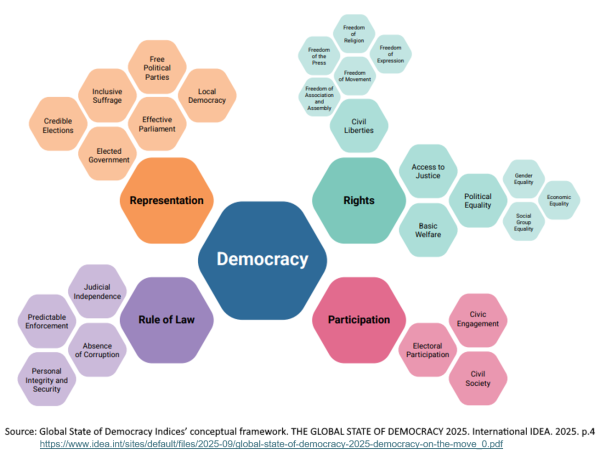
Summarizing the state of democracy is a complex task that goes far beyond simply holding elections to choose a government and encompasses many core elements and a wide range of indicators. Therefore, when addressing this issue in general terms, I find the conceptual framework for measurement offered by International IDEA’s analysis of the Global State of Democracy Indices [2], summarized in this image, to be appropriate:
Unlike previous editions, The Economist’s 2025 Democracy Index does not include the table with the index itself. Wikipedia, based on data from this index, which comprises 60 indicators, has presented the data for 2025, which is the information we will use for this assessment [3].
Plotted on a color-coded world map, this is the resulting image based on that data:
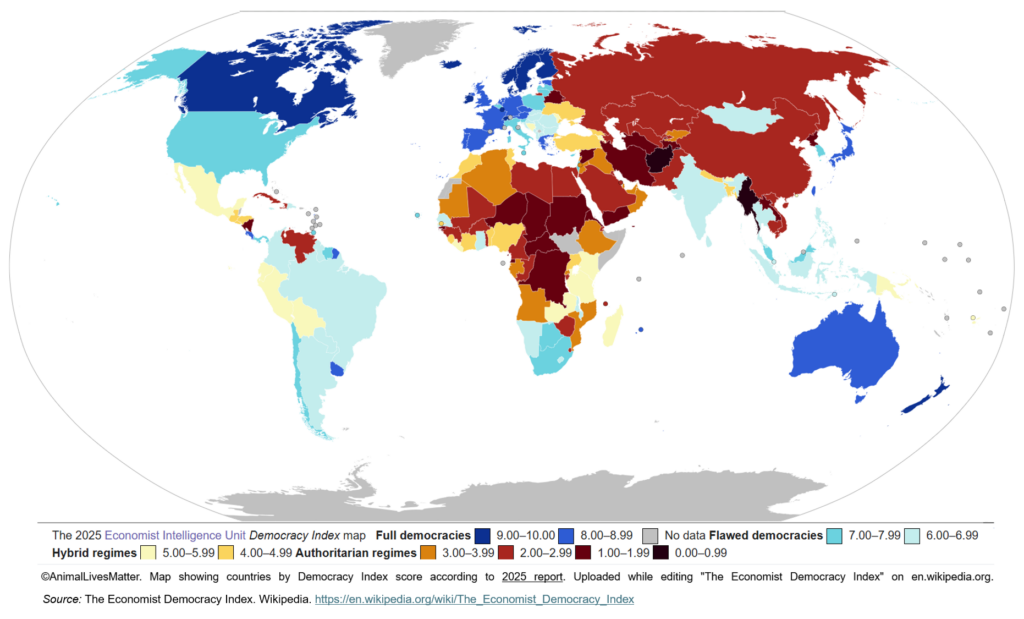
Using corresponding colors, the map shows the political regime in place in 2025 in each of the 165 countries included in the study, which are broken down as follows:
· 61 authoritarian (countries where political pluralism is nonexistent or severely limited), 2 of which are in Europe.
· 32 hybrid regimes (countries that typically experience electoral fraud, preventing them from being fair and free democracies), 3 of them in Europe.
· 48 imperfect democracies (countries where elections are fair and free, and basic civil liberties are respected, but which exhibit problems in some of the indicators used), 15 of them in Europe. In my opinion, a definition more in line with reality than this one would be “limited democracies” or “democracies with significant limitations” because, so far, in practice, there is no such thing as a perfect democracy.
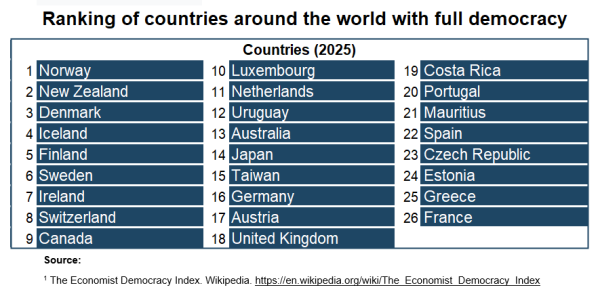
· 26 full democracies (countries where civil liberties and fundamental political freedoms are not only respected but also reinforced by a political culture conducive to the flourishing of democratic principles), 16 of them in Europe. Bearing in mind that the vast majority of these democracies are representative, heavily oriented toward electoral voting with the limitations that this implies, I believe a definition more in line with reality, and less exaggerated and grandiose, would simply be “democracies.”
In summary, in 2025 only 74 countries in the world were democratic (31 of them in Europe) and 93 were non-democratic (only 5 of them in Europe). It is alarming that these data confirm the trend toward the weakening of democracy worldwide over the past decades, since in 2024, as shown by the V-Dem Institute’s study, for the first time in more than 20 years, the world had fewer democracies (88) than autocracies (91) [4], the political model of choice among those who wish to organize and govern the world in their own image.
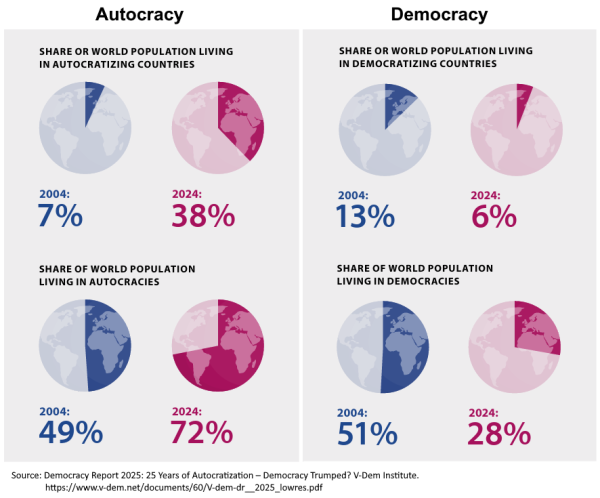
In light of what is happening in some countries in North America and Europe in 2026, I very much fear that, once some of the political processes currently underway in those countries are consolidated, these figures will not only continue the negative trend seen in the data recorded up through 2025, but historically democratic countries will also contribute very significant negative qualitative changes to the global state of democracy in 2027. We’ve been warned, so, as the saying goes, “we’d better be prepared.”
In 2025, only 26 countries in the world enjoyed what is defined as a full democracy, however limited that may be, given that it is excessively confined to its representative form. It is surprising how many democratic countries are not included in this table.
Unfortunately, today’s world is rife with evidence that representative democracy (which is the dominant form of democracy included in these indices) is in decline. This is documented by numerous studies from institutions in various countries that specialize in monitoring the health of democracy. Democracy, which since the 20th century has so unquestionably served humanity in advancing rights and equality, is not only stagnating, but there is troubling evidence that the rights of citizens (that is, the people) are increasingly being curtailed. Among the factors directly affecting this global trend are the state of four fundamental indicators of democracy: corruption, the justice system, citizen participation, and civil liberties.
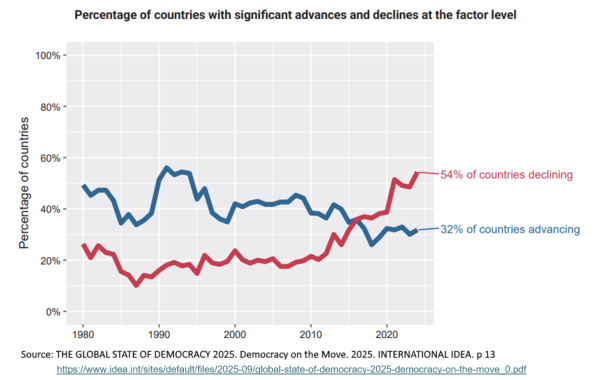
According to International IDEA, based on an extensive and detailed study of the elements and variables that directly impact the results summarized in the image below, global trends over the past decade show that democracy worldwide is clearly weakening. According to this study, in 2024, 54% of all countries evaluated (94) recorded a decline in at least one democratic performance factor from 2018 to 2023, while only 32% (55 countries) improved in at least one factor during that period [5].
Indicators of the Quality of Democracy
Among the many factors influencing this trend in representative democracy, in my opinion, three stand out in terms of our perception of the quality of democracy: corruption, the rule of law, and civil liberties.
Regarding corruption, the situation is clearly summarized in the 2025 Corruption Perceptions Report [6]:
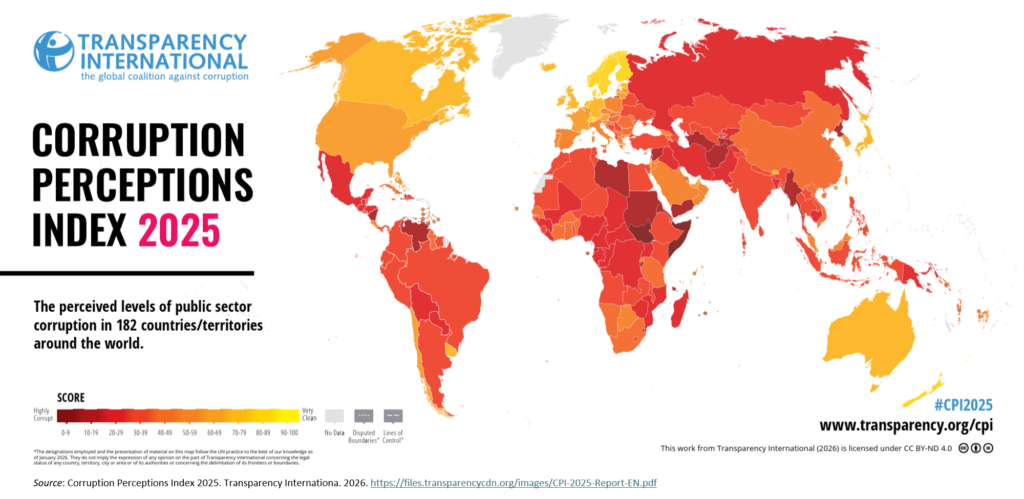
Too many intense colors (more intense = more perceived corruption) on the map showing how corruption is perceived in the public sector across 182 countries and territories worldwide. This is consistent with the fact that in a growing number of democracies around the world, anti-corruption authorities are being weakened, while corruption scandals are on the rise, and with the increasing evidence of attacks on judicial independence when it comes to enforcing the law against corrupt officials in power. If society in any way perceives that the adage “he who makes the law makes the loophole” holds true, it is inevitable that this will negatively impact its assessment of the dominant model of democracy.
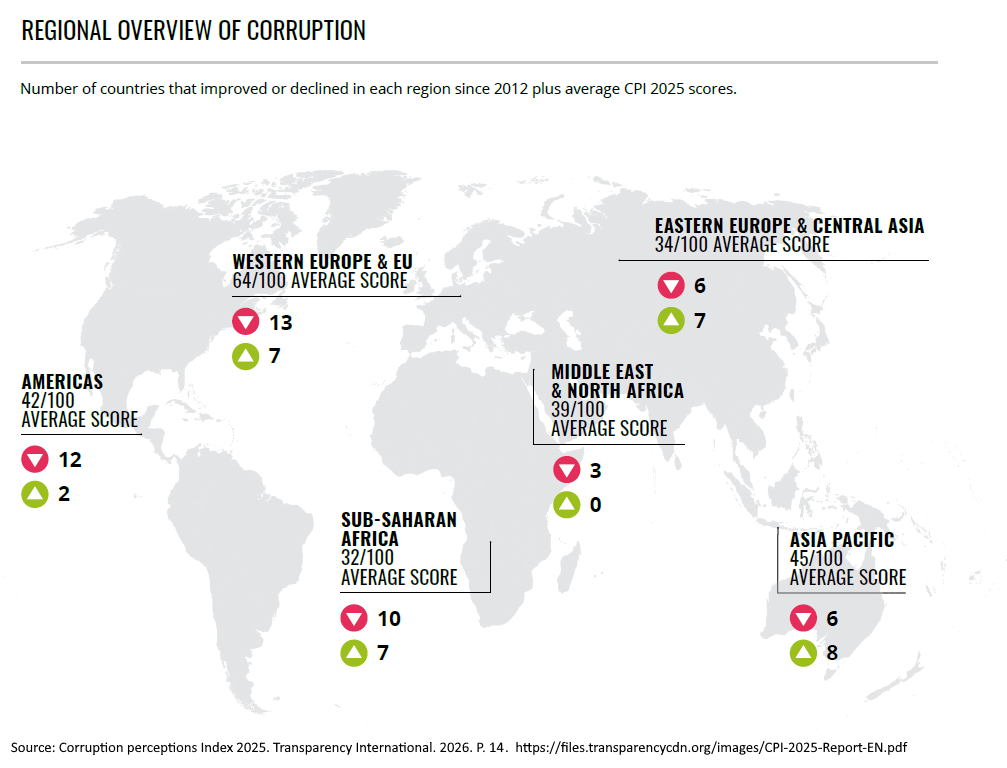
Therefore, more worrying than a snapshot of a single year is the downward trend in perceptions of corruption recorded over the last decade, and the danger that this could become endemic to the political system:
With regard to the justice system, the report on perceptions of the state of justice in 2025 [7] is no more encouraging than the one on corruption:
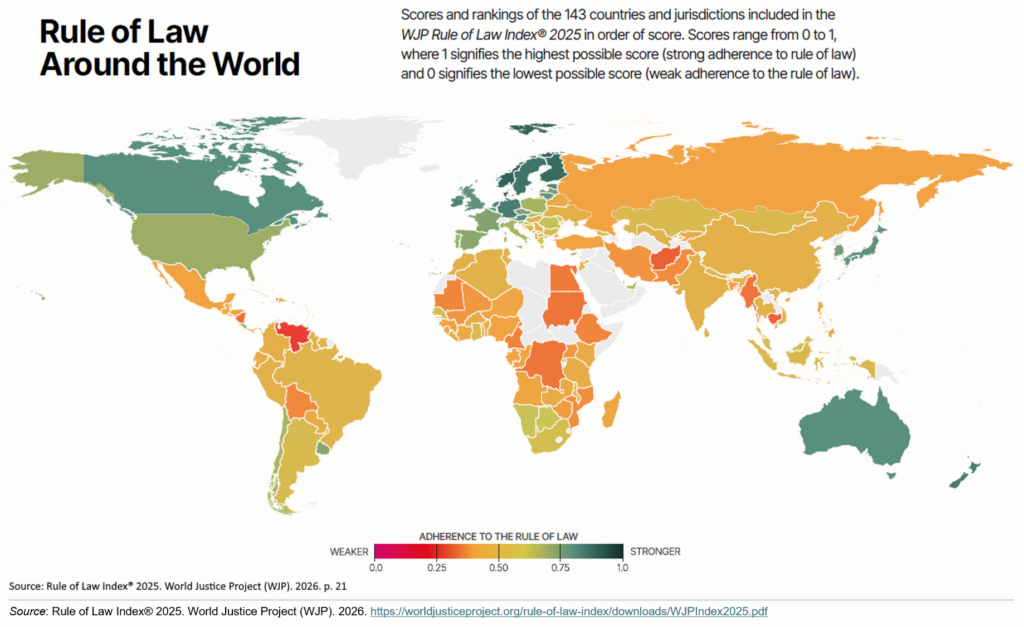
Very few countries on the map are shown in dark green (the greener the color, the better the state of the justice system), and there is an abundance of yellow and orange hues. And as can be seen below, the trend is even worse:
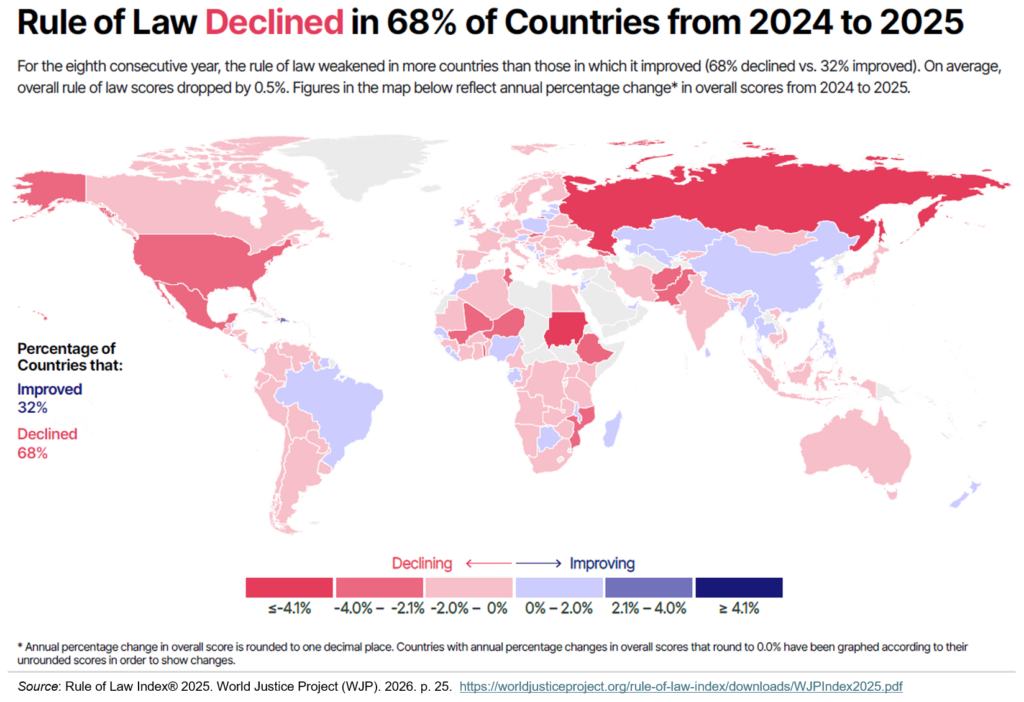
Too many countries on the map are colored in shades of pink and red due to the deterioration of the justice system and the right to due process. What is most alarming is that this decline includes countries with historically strong democratic track records.
Global freedom is also part of this negative trend in perceptions of the health of democracy; as shown in the Freedom House report, global freedom has declined consecutively over the past twenty years through 2025, and this trend includes countries such as the United States, Bulgaria, Italy, Hungary, and others [8]. It is alarming to note that “in a growing number of democracies, elected leaders are undermining the media, anti-corruption authorities, and judicial independence, thereby threatening fundamental freedoms and democracy” [9].
The global state of freedom in 2025 is so dismal that, as can be seen in the image below [10], 110 countries around the world (more than 56% of the 195 included on the map) do not enjoy freedom. Too many countries are shaded purple on this world map.
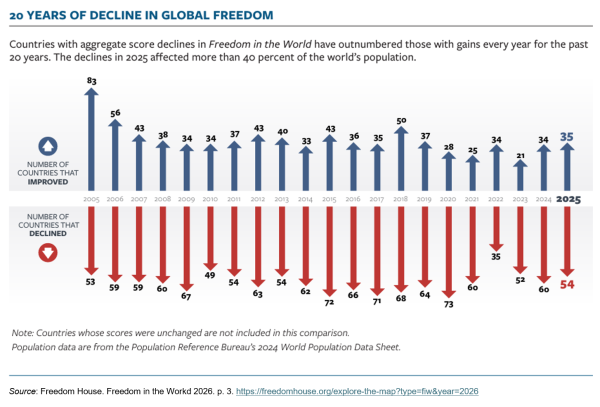
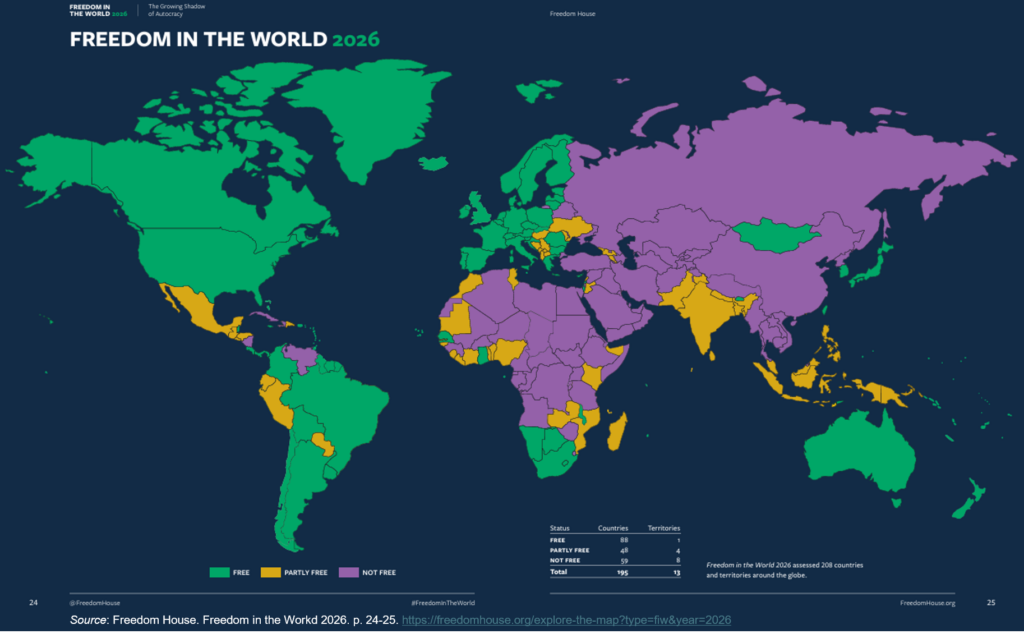
Of the many fundamental freedoms that have eroded over the past 20 years, freedom of the press and freedom of expression have been the hardest hit.
Fortunately, the world’s democratic countries are, for now, resisting the global trend of democratic decline. As can be seen in the table below, the 15 countries with the highest ratings for the quality of democracy in 2025 rank highly in all four fundamental categories:
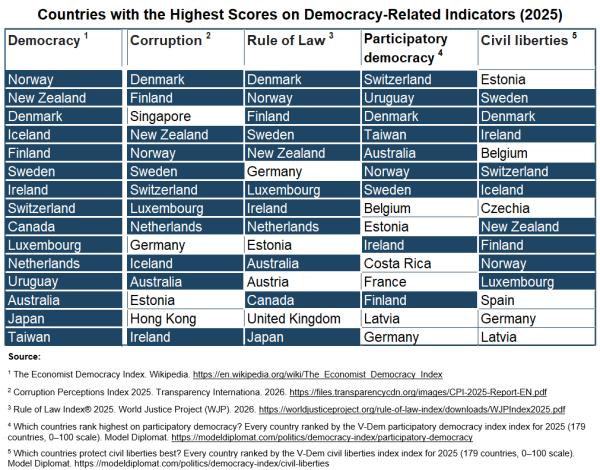
Only four countries (Denmark, Finland, Norway, and Ireland) are included among the fifteen countries in this table with the best scores in the four key categories used to measure the quality of democracy.
The table clearly shows that Denmark tops the rankings for these indicators. However, the scope of direct democracy in Denmark is limited to voting in certain referendums that can only be called by the government and parliament, beyond periodic elections for the government and parliament. In the country that leads the indicators of representative democracy, citizen groups cannot directly call for binding referendums, nor do they have mechanisms that allow citizens to modify or correct the decisions of their representatives, even when those decisions are entirely unpopular. I believe it is evident that Denmark’s mature democracy has clear room for improvement.
Uruguay also appears in the table, ranking a notable second in the participatory democracy indicator. In this country, citizen platforms and social organizations have a constitutional mechanism to call for referendums to repeal laws (this requires the prior collection, verified by the Electoral Court, of at least 25% of the signatures on the voter registry within one year of the law’s enactment), as well as plebiscites to introduce constitutional reforms (which require 10% of signatures). Uruguayan society makes responsible (and, in my opinion, exemplary) use of this right: from 1989 to 2026, it has successfully held four referendums and one plebiscite, the Water Plebiscite (2004). In response to the advance of drinking water privatization in Uruguay, the National Commission for the Defense of Water and Life spearheaded the plebiscite, which succeeded in amending the Constitution to enshrine access to drinking water as a fundamental human right, thereby permanently prohibiting its privatization [11].
Democracy and Social Progress
As shown in the table below, in 2025 the 15 countries with the highest rankings on the democracy index, even though they were not among the 15 richest countries in the world, also ranked highly on that year’s indices of social progress, quality of life, and human development:
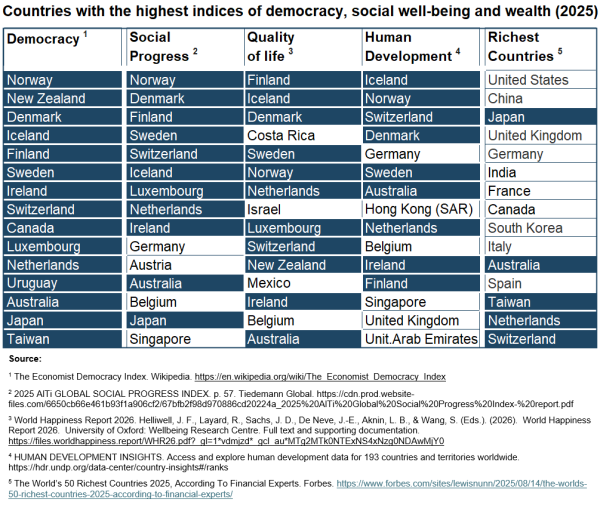
The index data in this table clearly show that countries with more advanced democracies are unquestionably fairer and more prosperous than the +90 non-democratic countries. Despite their questionable limitations, fully democratic societies are the ones that offer their citizens the greatest opportunities for freedom, progress, and well-being. This alone justifies any effort to strengthen democracy, making it more robust, effective, and less open to criticism by those who advocate for authoritarianism.
Norway’s recent history illustrates the evolution of a country that, thanks to its steadfast commitment to creating and maintaining a robust and transparent democratic system, went from being one of the poorest in Europe at the beginning of the 20th century to one of the countries with the highest levels of social progress, quality of life, and human development in the world. Crucial to this transformation has been the rigorous management of social wealth through a system of sovereign wealth funds [12], in which wealth truly belongs to all citizens, and its management is therefore integrated into the country’s democratic framework.
As we witness in real time what is happening in some democratic countries in 2026, let us hope that democracy will not only prove resilient and withstand the autocratic onslaught to which it is being subjected, but also contribute new forms and methods that allow for a deepening of its quality, the only way to have hope for its continued existence.
Transparency International’s recommendations for improving democracy [13] are aimed at:
· Ensure independent, transparent and accessiible justice institutions.
· Tackle undue influence on political decisión making.
· Givbe people harmed bu corruption Access to justice.
· Foster civic space and anti-corruption reporting.
· Enhance transparency and oversight in public services and public financial management.
· Prevent, detect and punish large-scale corruption and illicit financial flows.
For its part, the Brookings Institution’s Democracy Playbook 2025 [14] outlines seven pillars for defending democracy:
Pillar 1: Protect Elections
Pillar 2: Defend Rule of Law
Pillar 3: Fight Corruption
Pillar 4: Reinforce Civic and Media Space
Pillar 5: Protect Pluralistic Governance
Pillar 6: Counter Disinformation
Pillar 7: Make Democracy Deliver
All of these recommendations are interesting and valid, but the reality is that it will be difficult for solutions to emerge solely from actions that are, above all, limited to the deteriorating realm of traditional representative democracy and those who manage it. In the current context, the challenge lies not only in how to efficiently implement these recommendations within a deeply distorted and increasingly inefficient representative model, but also, given the trend toward the constant decline in democratic quality on a global scale, in ensuring that the key questions regarding the success of these efforts address the necessary answers regarding who will carry them out and how they will be implemented.
Summary
The Democracy Index and the other sources used to conduct this measurement are based, to a large extent, on the representative democracy that we know and value so well, with an emphasis above all on electoral processes, institutions, and political participation. Within this framework, the elements and indicators of direct democracy play a limited role. A good example of this is Switzerland, which combines a representative democratic system with refined instruments for the exercise of direct democracy, through which citizens can participate in decisions on local, regional, and national issues via three or four votes per year, a fact that receives limited recognition in the methodologies used to generate these statistics.
No matter how much representative democracy is presented to us as the pinnacle of its maturity, the reality is that it is merely a historical, transitional form of democracy, one that emerged as a natural, valid, and highly useful response to
the real limitations on the exercise of broader and more direct forms of democracy, as well as to the impracticality of effectively exercising it on a mass scale given the need for the physical presence of representatives to validate their authenticity. Currently, representative democracy is the dominant form of democracy worldwide; however, in order to grow and become more robust, and to successfully respond to new social needs and the possibilities offered by information technologies, it will have to coexist with new and traditional forms of direct democracy. The cases of Switzerland and Uruguay, which have successfully combined representative democracy with the exercise of direct democracy, could serve as a source of inspiration for advancing toward the ultimate goal: more democracy.
As indicated by the various studies cited above, the findings of the global assessment of the state of democracy we share today are far from encouraging: we live in a world with fewer democracies than autocracies. There are more countries in the world where the data indicates that democracy is dead (or nearly dead), and only a small handful of countries where it is alive, healthy, and resilient. And the worst part is the trend: autocracies are growing the most, and at the fastest rate.
Based on the data used to calculate the 2025 The Economist Democracy Index, the current state of democracy around the world, by region, is roughly as follows [15]:
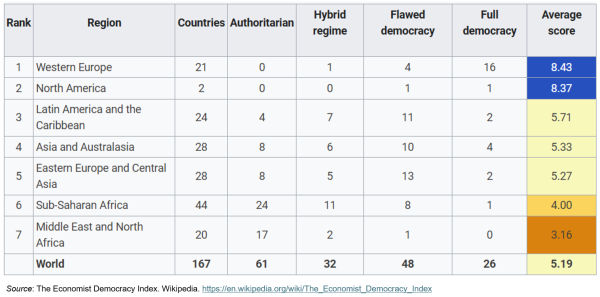
It is clear that Europe, with its 31 democratic countries (16 full democracies and 15 imperfect democracies) and 5 non-democratic countries (3 hybrid regimes and 2 authoritarian regimes), has the best overall indicators of the state of democracy in the world. Despite the political pressures on democracy it is currently facing, this region is best positioned to advance democracy and to create new ways, forms, and methods of citizen participation in the democratic system that will improve results in future assessments.
At the other extreme is the Middle East and North Africa region, where, with the exception of one country with an imperfect democracy (Israel), the rest are non-democratic countries. As difficult as it may be, even the smallest shift in these countries toward imperfect democracies will be a major success.
Over the past fifteen years, the application of information technologies has led to a rapid digitization of society that is drastically changing the ways and means through which we conduct a significant portion of our social, economic, institutional, political and democratic relationships, among others. All of this is also having a rapidly growing impact on relations of production and power and, consequently, on the ways in which democracy will be practiced. Welcome to the
dawn of the digital age.
Unless one wishes to deny the evidence (something that has recently become very fashionable, much like flat-Earth theory), the future of humanity, among many other characteristics, will be digital or virtual, as I would like to continue
emphasizing when referring to the result of the digitization of social processes and relationships [16]. The digitization of human activity, as Pierre Lévy so aptly envisioned back in 1999, which now seems like a distant past, “also influences our forms of collectivity: virtual communities, virtual companies, virtual democracy. Although the interconnection of the world’s computers in cyberspace plays a crucial role in the ongoing transformations, it is a backdrop that has come to far exceed computerization itself” [17].
Of course, these transformations resulting from digitization also include the State and democracy. Sooner rather than later, the digitization of its institutions and political system will also profoundly transform the organization and management of the democratic system. As a result, democracy will gradually become digital, or it can be expressed using any of the more obsolete terms that have been applied to this matter, such as virtual, electronic, or “cyberdemocracy” [18], etc. And most importantly, regardless of the term used, it will bring about greater democracy.
Because of its limited maturity and the current limitations of information technology, digital democracy is currently focused primarily on extending certain elements of representative democracy to the digital realm. As a result, digital democracy is generally limited to improving various forms of citizen participation, transparency, and information about electoral processes. This is all well and good, of course, but it’s a long way from a mature digital democracy. The latter would also incorporate digital forms of direct democracy to strengthen it.
Secure and responsible digitization will overcome the historical limitations of the current political system, which requires the physical presence of a small number of citizens’ representatives. It will enable us to:
· Offer unprecedented opportunities to strengthen democracy and implement new forms of direct participation and digital interaction on a societal scale with appropriate safeguards. Furthermore, it will ensure real-time transparency in governance.
· Practice democracy in broader, more routine, continuous, direct, and decisive ways than we are accustomed to. Create new democratic forms and mechanisms that simplify the implementation of legal options, such as referendums and plebiscites. Minimize the excesses of those who, once elected, undermine the principles of democracy between elections despite having attained their positions thanks to democracy itself.
· Empower citizens with effective tools for participating in political debates and concrete decision-making. These tools can counteract the growing threats to democracy posed by:
o Lobby groups that defend private interests, which often conflict with the public interest.
o The immense power that arises from the concentration of wealth in the hands of a select few, whether individuals or corporations, and the “techno-libertarians” [19] who dream of creating and managing their own “city-states” (whether called Charter Cities, Startup Cities, Free Cities, Seasteading, etc.) as if they were private companies, governed by a system of laws and institutions that are distinct from and take precedence over those of the country in which they are established (if this scenario were to come to pass).
Given its profound impact on the current representative democratic system, to which so many interests are tied, as well as on the dominant spheres of power, the advancement of digital democracy will not be easy or straightforward. The political will required to achieve it is undeniable.
Among other things, a mature and robust democratic State serves as a guarantor of social justice, individual and collective rights, freedom, equality, and progress. This is because it reflects a highly civilized society, capable of providing a solid framework for coexistence and tolerance, as well as playing an active role in relation to the state itself.
More than wealth itself (which is unquestionably necessary), it is democracy that offers society the most appropriate tools for the efficient and transparent management of social wealth and, thereby, provides the greatest opportunities for the progress and well-being of citizens. Therefore, anything that undermines democracy also undermines social progress and freedom; anything that does not contribute to strengthening democracy is unlikely to lead to sustainable social progress and well-being. It is no coincidence that totalitarians, dictators, and autocrats display such visceral hatred toward anything that “smells” of democracy.
Bearing in mind the results of assessments of the current state of democracy and its global trends over the past twenty years, I believe it is necessary to recognize the vital importance of what is at stake for humanity right now.
Progress toward digital democracy requires a solid foundation. In addition to necessary structural, legal, political, and cultural changes, public administrations have a technological responsibility to create, provide, maintain, and expand effective, resilient, highly secure, and reliable digital public infrastructures (DPIs). Furthermore, as I will explain in the final article of this trilogy, if DPIs are to meet the highest security standards, satisfy the ever-increasing and changing needs of democratic societies and achieve a mature digital democracy, they will need to start incorporating quantum technologies into their digital systems sooner rather than later.
To understand this important technological indicator for the present and future of digital democracy, the next article will focus on measuring the state of DPIs.
[1] Erwin Schrödinger. https://es.wikipedia.org/wiki/Erwin_Schr%C3%B6dinger
[2] The Global State of Democracy 2025. Democracy on the Move. International IDEA. 2025
https://www.idea.int/sites/default/files/2025-09/global-state-of-democracy-2025-democracy-on-the-move_0.pdf
[3] The Economist Democracy Index. Wikipedia. https://en.wikipedia.org/wiki/The_Economist_Democracy_Index
[4] Nord, Marina, David Altman, Fabio Angiolillo, Tiago Fernandes, Ana Good God, and Staffan I. Lindberg. 2025. Democracy Report 2025: 25 Years of Autocratization – Democracy Trumped? University of Gothenburg: V-Dem Institute. https://www.v-dem.net/documents/61/v-dem-dr__2025_lowres_v2.pdf
[5] The Global State of Democracy 2025. Democracy on the Move. Chapter 2 Global Patterns, p. 13. International IDEA. 2025 https://www.idea.int/sites/default/files/2025-09/global-state-of-democracy-2025-democracy-on-the-move_0.pdf
[6] Corruption Perceptions Index 2025. Transparency Internationa. 2026. https://files.transparencycdn.org/images/CPI-2025-Report-EN.pdf
[7] Rule of Law Index® 2025. World Justice Project (WJP). 2026. https://worldjusticeproject.org/rule-of-law-index/downloads/WJPIndex2025.pdf
[8] FREEDOM IN THE WORLD 2026. The Growing Shadow of Autocracy. Freedom House. 2026. https://freedomhouse.org/sites/default/files/2026-03/FIW2026_final_digital%20%281%29.pdf
[9] FREEDOM IN THE WORLD 2025. The Uphill Battle to Safeguard Rights.p. 16. Freedon House. https://freedomhouse.org/sites/default/files/2025-02/FITW_World_2025_Feb.2025.pdf
[10] Freedom House. Freedom in the World. https://freedomhouse.org/explore-the-map?type=fiw&year=2026
[11] Ley N° 18610. LEY DE POLITICA NACIONAL DE AGUAS. PRINCIPIOS RECTORES. Normativas y Avisos Legales del Uruguay. Centro de Información Oficial. https://www.impo.com.uy/bases/leyes/18610-2009
[12] Government Pension Fund Global. About the fund. Norges Bank Investment Management. https://www.nbim.no/en/about-us/about-the-fund/
[13] Corruption Perceptions Index 2025. Transparency Internationa. 2026. https://files.transparencycdn.org/images/CPI-2025-Report-EN.pdf
[14] DEMOCRACY PLAYBOOK 2025. SEVEN PILLARS TO DEFEND DEMOCRACY IN 2025 AND BEYOND. The Brookings Institution January 2025. https://www.brookings.edu/wp-content/uploads/2025/01/v4_democracy-playbook-2025.pdf
[15] The Economist Democracy Index. Wikipedia. https://en.wikipedia.org/wiki/The_Economist_Democracy_Index
[16] So much so that in 1998 I designed, and later taught for two years at the Catholic University of Uruguay, a course related to what was then the nascent field of e-commerce, which I titled “Management of Virtual Enterprises.” Twenty-eight years later, given that the content was aimed at illustrating the scope of the transformations taking place in production and service relations, the title remains valid.
[17] Lévy. P. ¿Qué es lo virtual? Editorial Paidós. 1999.
[18] Lévy, P. Ciberdemocracia. Ensayo sobre filosofía política. Editorial UOC. 2002.
[19] Alloa, E. Le coup d’État des techno-libertariens. Esprit, Nº 519, 2025, pp. 13-16. https://shs.cairn.info/revue-esprit-2025-3-page-13?lang=fr&tab=premieres-lignes

